Excerpt from “Practical Religion,” (pg. 103) by J. C. Ryle
BIBLE-READING. The time would fail me if I were to enter fully into all the great things which are to be found in the Bible, and only in the Bible.
It is not by any sketch or outline that the treasures of the Bible can be displayed. It would be easy to fill this volume with a list of the peculiar truths it reveals, and yet the half of its riches would be left untold.
How glorious and soul-satisfying is the description it gives us of God’s plan of salvation, and the way by which our sins can be forgiven!
The coming into the world of Jesus Christ, the God-man, to save sinners,—the atonement He has made by suffering in our stead, the just for the unjust,—the complete payment He has made for our sins by His own blood,—the justification of every sinner who simply believes on Jesus,—the readiness of Father, Son, and Holy Ghost, to receive, pardon, and save to the uttermost,—how unspeakably grand and cheering are all these truths!
We should know nothing of them without the Bible.
How comforting is the account it gives us of the great Mediator of the New Testament,—the man Christ Jesus! Four times over His picture is graciously drawn before our eyes. Four separate witnesses tell us of His miracles and His ministry,—His sayings and His doings,—His life and His death,—His power and His love,—His kindness and His patience,—His ways, His words, His works, His thoughts, His heart.
Blessed be God, there is one thing in the Bible which the most prejudiced reader can hardly fail to understand, and that is the character of Jesus Christ!
The battles could be secret addictions, bitterness, resentment, or anger that are not confessed or forsaken.
I watched Dr. Hershael W. York’s YouTube video, “The Private Battles Pastors Face,” and the AI generated summary of the video was incredibly accurate, so I share it here, vouching for its reliability.
York is the Dean of the School of Theology of The Southern Baptist Theological Seminary.
Here’s the video summary regarding the hidden struggles pastors often experience.
Dr. Hershel York highlights several challenges (0:36):
Loneliness and Isolation (1:00): Pastors often feel alone, even in a crowd, due to the unique nature of friendships within the church and a lack of peers who understand leadership burdens.
Insecurity and Comparison (2:01): Pastors may feel they don’t measure up to other preachers or churches, leading to feelings of inadequacy.
Spiritual Dryness (2:26): Periods of drought where pastors may preach without feeling the fire, struggling to maintain a private devotional life amidst constant public spiritual duties.
Unprocessed Grief or Trauma (3:15): Personal losses like child loss, parental death, marital difficulties, or spouse loss can significantly impact pastors, who are still expected to shepherd and preach despite their own pain.
Hidden Sin Struggles (3:58): Secret addictions, bitterness, resentment, or anger that are not confessed or forsaken.
Dr. York also explains why pastors often don’t talk about these battles (4:24):
Fear of losing credibility. The belief that they must appear strong and be a spiritual example. However, he emphasizes that pastors are weak and broken, and only Jesus is the true example (4:40).
To overcome these struggles, Dr. York suggests (5:00): 1. Name the battle (5:07): Acknowledge and identify the specific struggle to begin the process of repentance and healing.
2. Find a safe mentor/person (5:37): Someone outside the church, of the same sex, who understands the unique challenges of ministry, such as a counselor or trusted friend.
3. Pursue spiritual health over metrics (6:31): Focus on soul health, consistent spiritual rhythms (Sabbath rest, daily scripture reading for personal growth, not just sermons), and bringing glory to Christ, rather than outward church growth statistics.
4. Preach the gospel to yourself (7:40): Remind yourself that salvation and endurance are by grace, and walk by faith, recognizing that God has called you and provides grace to endure all challenges.
The video concludes with a powerful reminder that pastors are not alone, crazy, or hopeless (8:21), and God provides the Holy Spirit and His Word to help them endure and find healing for their souls, which is crucial for healthy ministry (9:36).
Knowledge not tempered with love of God produces bloated, puffed-up know-it-alls.
“Why is it that people with PhDs in theology commit adultery? They don’t know God.
“You can read theology ten hours a day for fortyyears and not know God as beautiful and all-satisfying — as the highest treasure of your life. Who cares about knowing God the way the devil knows God? He hates everybody. His knowledge of God helps him hate people.
We’re talking about knowing God here in 1 Thessalonians. They don’t know God. They don’t know God for who he is — infinitely valuable, infinitely beautiful, infinitely satisfying — why your soul was made. There are more pleasures at his right hand, more eternal joys in his presence, than you could have in ten thousand sexual trysts. If you know that, sin will have lost its dominion in your life.
Lament: “to have or express very sad feelings about somebody or something.”
Excerptfrom the Intro to the Book of Lamentations in the Life Application Study Bible (1996).
TEARS are defined simply as “drops of salty fluid flowing from the eyes.” They can be caused by irritation or laughter but are usually associated with weeping. sorrow, and grief. When we cry, friends wonder what’s wrong and try to console us. Babies cry for food: children cry at the loss of a pet; adults cry when confronted with trauma and death.
Jeremiah’s grief ran deep. He is remembered as the “weeping prophet,” and his tears flowed from a broken heart. As God’s spokesman, he knew what lay ahead for Judah, his country, and for Jerusalem, the capital and the city of God.” God’s judgment would fall and destruction would come. And so Jeremiah wept. His tears were not self-centered, mourning mover personal suffering or loss. He wept because the people had rejected their God–the God who had made them, loved them, and sought repeatedly to bless them. Jeremiah’s heart was broken because he knew that the selfishness and sinfulness of the people would bring them much suffering and an extended exile. Jeremiah’s tears were tears of empathy and sympathy. His heart was broken with those things that break God’s heart. Jeremiah’s two books focus on one event the destruction of Jerusalem. The book of Jeremiah predicts it, and Lamentations looks back on it. Known as the book of tears, Lamentations is a dirge, a funeral song written for the fallen city of Jerusalem.
What makes a person cry says a lot about that person-whether he or she is self-centered or God-centered. The book of Lamentations allows us to see what made Jeremiah sorrowful. As one of God’s choice servants, he stands alone in the depth of his emotions, broken by his care for the people, his love for the nation, and his devotion to God.
What causes your tears? Do you weep because your selfish pride has been wounded or because the people around you lead sinful lives and reject the God who loves them dearly? Do you weep because you have lost something of value or because people all around you will suffer for their sinfulness? Our world is filled with injustice, poverty, war, and rebellion against God, all of which should move us to tears and to action. Read Lamentations and learn what it means to grieve with God.
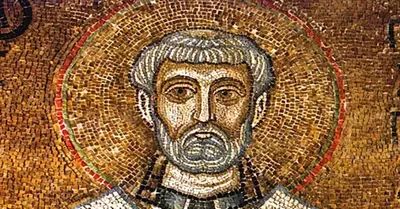
Clement of Rome wrote to the church at Corinth, which was a 4-7 day journey by sea.
Audio Transcript of this Post:
The First Epistle of Clement was written in a time of crisis in the church in Corinth, so I don’t want to leave Clement where I left off yesterday, i.e., only discussing his commentary on the phoenix. That would be akin to the Corinthians focusing on issues that were non-essential, as Clement argues in his letter.
And while the letter is more than 2,000 years old, it’s surprisingly very relevant to our day. Imagine you’re attending a church that is so divided, there’s an actual “sedition against the leadership of their church.” 1Clem 47:5-6. That was the issue confronting Clement. However, it was more than that, because this wasn’t a case of good laypeople throwing out bad leaders. This was a “detestable and unholy sedition,” (IClem 1:1) which had ruined the reputation of the local church, according to Clement.
Clement described the incident as “righteous persons have been thrust out by holy men,” (1Clem 45:4), an action he pointed out, for which there is no precedent in Scripture.
From Clement’s assessment, at the root of the problem was pride, the sin that’s as old as time itself, and jealousy. The party responsible for the division needed to repent and submit to leadership, he wrote.
One of the fascinating aspects of this letter is that modern readers who’ve attended a church for any length of time will be all-too familiar with internal divisions, power struggles, and hurt within the local church. In this case, Clement tells his audience they didn’t always have these problems. Given Paul’s previous two letters to the Corinthian church, one wonders if perhaps they cleaned up their act, albeit momentarily, following the apostle’s New Testament letters? Clement noted that the church in Corinth used to be marked by “.. a profound and rich peace,” that “was given to all, and an insatiable desire of doing good. An abundant outpouring also of the Holy Spirit fell upon all,” I Clem 2:2. This was so evident that they used to be “free from malice one towards another,” I Clem 2:5
(This raises theological questions about the role of the Holy Spirit in Corinth’s current predicament, but that’s a subject for a different discussion).
Consider how this church conflict differed from any you may have experienced in your lifetime. Some of these church members were contemporaries of Jesus Christ and eyewitnesses to the Crucifixion! They were complimented by Clement for “…giving heed unto His words, ye laid them up diligently in your hearts, and His sufferings were before your eyes,” I Clem 2:1
And in this way he complimented their former spiritual state: “you were all lowly in mind and free from arrogance, yielding rather than claiming submission, more glad to give than to receive, and content with the provisions which God supplied,” I Clem 2:2. Then came a day when that wasn’t enough. They just weren’t satisfied.
Their downfall—pride and a turning away from God—came after they experienced some prosperity, according to Clement (I Clem 3:1-3). How little human nature has changed since then, eh? When money and things become an idol, we reject the Savior who owns it all—does that make sense?
Clement’s letter is written with much pastoral care! He reminds them that God “desires not the death of the sinner, so much as his repentance,” and, in His mercy, God told his people to repent, “wash and be clean,” IClem 8:3-5
It’s actually rather encouraging from our perspective today looking back at an early church leader, saddened by the deep divisions in the local church, who pleaded and admonished them to end their squabble and be the church. The letter was clearly written by someone who had close proximity to Paul and/or his writings, and who was also a man with (not surprisingly) deep familiarity with the Hebrew scriptures. He gives many examples of people in the Bible who serve as examples for us, either in their humility or in their failures, including Cain and Abel, Noah, Moses, Rahab, Judith, Esther and David.
Since we’ve been saved by the riches of God’s grace, and not our works, Clement wrote, we ought to seek to live in unity and love with the brethren, 1Clem 57:1-2. “Let us therefore root this [conflict] out quickly, and let us fall down before the Master and entreat Him with tears, that He may show Himself propitious and be reconciled unto us, and may restore us to the seemly and pure conduct which belongeth to our love of the brethren.” 1Clem 48:1
“Love joineth us unto God; love covereth a multitude of sins; love endureth all things, is long-suffering in all things. There is nothing coarse, nothing arrogant in love. Love hath no divisions, love maketh no seditions, love doeth all things in concord. In love were all the elect of God made perfect; without love nothing is well pleasing to God,” 1Clem 49:5
I’m reminded of Jesus’ words in John 13:35: “By this everyone will know that you are my disciples, if you love one another.”
Based on the internal evidence of the letter, the First Epistle of Clement was written before the fall of Jerusalem in 70 AD (it mentions ongoing temple sacrifices) and it also mentions the gospel. Compare this gospel in I Clement to the one you’re familiar with in the New Testament:
“Let us fix our eyes on the blood of Christ and understand how precious it is unto His Father, because being shed for our salvation, it won for the whole world the grace of repentance,” 1Clem 7:4
“And so we, having been called through His will in Christ Jesus, are not justified through ourselves or through our own wisdom or understanding or piety or works which we wrought in holiness of heart, but through faith, whereby the Almighty God justified all men that have been from the beginning; to whom be the glory for ever and ever. Amen,” 1Clem 32:4
“In love the Master took us unto Himself; for the love which He had toward us, Jesus Christ our Lord hath given His blood for us by the will of God, and His flesh for our flesh and His life for our lives,” 1Clem 49:6
“Ye see, dearly beloved, how great and marvelous a thing is love, and there is no declaring its perfection,” 1Clem 50:1
There’s much here that resonates with Paul’s writings but, ultimately, this letter was rejected as part of the cannon, and no doubt Clement’s decision to include the story of the Phoenix which I wrote about last time played a major role in doubting it’s in divine inspiration. However, the church in Corinth did resolve this matter eventually. And Clement, according to tradition, died a martyr.
The Phoenix, popular in ancient times, and a modern-day Bible, are pictured in a Roman setting.
Audio Transcript of this Post:
Toward the end of the Era of the Apostles, near the close of the first century, Clement of Rome, who knew the apostles of Jesus personally, wrote this amazing story when he was an early church bishop to the troubled church in Corinth:
“There is a bird, which is named the phoenix. This, being the only one of its kind, lives for 500 years; and when it has now reached the time that it should die, it makes for itself a coffin … and so dies.
“But, as its flesh rots, a certain worm is engendered, which is nurtured from the moisture of the dead creature, and puts forth wings. Then, when it is grown lusty, it takes up that coffin which contain the bones of its parent and, carrying them, journeys from the country of Arabia even to Egypt, to the place called the City of the Sun; and in the daytime in the sight of all, flying to the altar of the Sun, it lays them thereupon; and this done, it sets forth to return.
“So the priests examine the registers of the times, and they find that it has come when the five hundredth year is completed.”
Clement used this very well-known story of his day to make the resurrection of Christ relatable to his audience:
“Do we then think it to be a great and marvelous thing, if the Creator of the universe shall bring about the resurrection of them who have served Him with holiness in the assurance of a good faith, seeing that He shows to us even by a bird the magnificence of His promise?”
Modern-day translation:”Should we really think it’s such a great and unbelievable thing that the Creator of the universe will raise to life those who have served Him faithfully and with sincere hearts—especially when He even uses a bird to show us how amazing His promise is?”
The trouble is, Clement wrote this story as if it were true. Nowhere does he discredit the fable about the Phoenix as a myth of the pagans. He accepts it, according to this one writing. He even adopts it as part of his argument addressing a bigger issue regarding conflict in the church.
To be sure, the Phoenix story appears nowhere in the Bible; however, you can read about the bird in the First Epistle of Clement here. The Greek historian Herodotus (the “father of history”) wrote that he had heard about this bird from the Egyptians, but that he’d never personally seen one. But Herodotus didn’t call it a fable and discredit it, either. (Other ancient records also mention the Phoenix).
For their part, the Egyptians’ side of this story couldn’t be proven until more than 2,000 years after Herodotus made his claim. That’s because it wasn’t until 1881 that an Egyptian source was discovered that substantiated Herodotus’ claim about the local legend. Underneath an Egyptian pyramid (relax “Ancient Aliens” devotees)–was graffiti on the walls. Actually, it was hieroglyphic text which described a bird, the Bennu, who historians say was likely an earlier version of the phoenix as they shared similar properties such as self-creation and divine origins. I won’t get into the Egyptian gods that came into play here, as it can get rather academic; instead, I want to suggest a possible theory on where the Egyptians might have gotten their bird narrative.
With humanity’s origins in the Garden, people spread out over the earth with varying recollections of the past, modifying the historical facts of creation and God with their own twists and takes. Scholars like the late Dr. Michael Heiser have discussed this phenomenon in terms of the “collective memory” of people who all shared the same experience in Great Antiquity. The people would all write about it and have a version of those events, he noted. This view is more likely to be the case than the out-of-date view that suggests the Biblical writers simply copied earlier versions of famous bible stories from their neighbors (see Heiser’s explanation on that, here).
Ok, fine. That still doesn’t get us past the problem of why would a bishop from the first century– who tradition suggests knew the apostle Peter or Paul (Phillipians 4:3)–believe in something no one in or out of today’s scientific community would propagate? I mean, if Clement’s not faithful in the little things, how can we trust him in the big things?
Ouch.
In reality, here’s why it’s not that simple in this case. There’s a tendency in studying history to project the present into the past rather than leaving the past in its proper historical context and trying to understand it within that context (and not ours). Clement wasn’t knowingly creating myth, or modifying an existing story he borrowed from the pagans, or retelling a story he knew was scientifically false; rather, it’s far more likely –if he keep him in his historical context — that he was only sharing what was widely regarded as credible and reliable natural science in the first century to make a larger point about the gospel. The degree to which the Phoenix story seems strange and bizarre to us is the degree to which we’re familiar with a lot of non-scientific stories of past (or present) cultures.
“Wait,” you may protest! “You must be trying to defend him because he was an early church father.” If you believe that, then think of it this way:
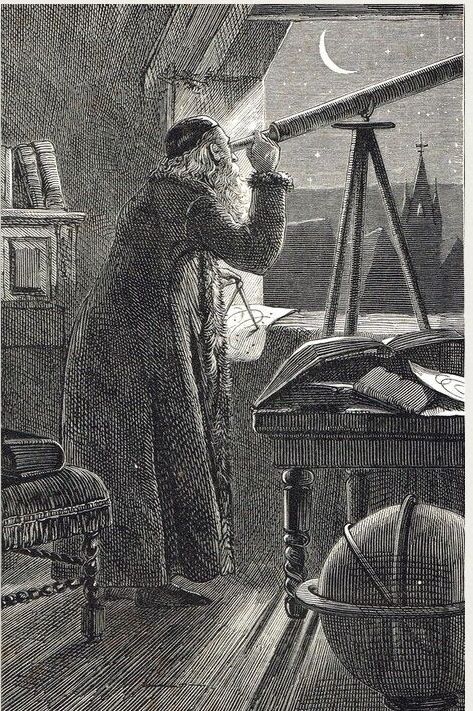
Many people today seem to forget that when Copernicus peered through his telescope and pronounced that the earth was not the center of the universe, he was directly contradicting the accepted, established science of the day. The scientific community was on the church’s side and both were initially against the Polish astronomer. What’s my point? You can easily picture churchmen writing in Copernicus’ day about Jesus’ death and resurrection and noting–at the same time–something like, “As the earth is the center of the universe, so ought Jesus to be the center of our lives.” Except today we know better: the earth is not the center of the universe. (In fact, Earth is the biological center of the universe. And Jesus should still be the center of our lives, ehem).
Copernicus observing the stars.
We learn more about the physical world each day such that the “science” of today becomes falsifiable (non-scientific) tomorrow. Ponder that!
But Jesus Christ “is the same yesterday, today and forever.” (Hebrews 13:8)
One last thought on which I’ll end: Clement’s writings are not part of the Bible, the Word of God. That’s a very important distinction.
The Introduction to the Apostolic Fathers book I’m reading published in the 1800s, noted this, which is something to keep in mind when you read the Church Fathers):
“Their very mistakes enable us to attach a higher value to the superiority of the inspired writers. They were not wiser than the naturalists of their day who taught them the history of the Phœnix and other fables; but nothing of this sort is found in Scripture.
“The Fathers [or their writings] are inferior in kind as well as in degree [in comparison to Scripture]; yet their words are lingering echoes of those whose words were spoken ‘as the Spirit gave them utterance.’ They are monuments of the power of the Gospel.”
“As we read the Apostolic Fathers, we comprehend, in short, the meaning of St. Paul when he said prophetically, what men were slow to believe, ‘The foolishness of God is wiser than men; and the weakness of God is stronger than men … But God hath chosen the foolish things of the world to confound the wise; and God hath chosen the weak things of the world to confound the things which are mighty; and base things of the world, and things which are despised, hath God chosen, yea, and things which are not, to bring to nought things that are.’ (December 1884).
Amen.
Tomorrow: To reduce Clement to this commentary about the phoenix would be akin to the Corinthians focusing on issues that were non-essential, which is an argument Clement makes in this letter to them. So tomorrow, Lord willing, let’s take a deep dive, a more balanced view of the letter itself, and a more complete picture of this First Century Christian will emerge.
Psalm 139, For the choir director: A psalm of David
If I go to the moon, God is there.
This post is divided into 2 parts: The Word of God in Psalm 139, and my personal reflections written during early morning devotion.
1 O Lord, you have examined my heart and know everything about me.
2 You know when I sit down or stand up. You know my thoughts even when I’m far away.
3 You see me when I travel and when I rest at home. You know everything I do.
4 You know what I am going to say even before I say it, Lord.
5 You go before me and follow me. You place your hand of blessing on my head.
6 Such knowledge is too wonderful for me, too great for me to understand!
7 I can never escape from your Spirit! I can never get away from your presence!
8 If I go up to heaven, you are there; if I go down to the grave,[a] you are there.
9 If I ride the wings of the morning, if I dwell by the farthest oceans,
10 even there your hand will guide me, and your strength will support me.
11 I could ask the darkness to hide me and the light around me to become night—
12 but even in darkness I cannot hide from you. To you the night shines as bright as day. Darkness and light are the same to you.
My Personal Reflections (not AI generated)
To us, God often feels far away yet the Psalmist declares plainly that God is everywhere—and not just everywhere, but active. If you’re in the most non-religious environment, far from a church or Christian bookstore, or anything that remotely points to God, God is there, says the Psalmist. We need spiritual eyes to recognize this reality, or we will not see it. We might erroneously think God is in this space, but not that space. God, however, does not dwell in buildings made by men–God created Heaven and Earth and everything in it (Acts 17:24). The Spirit of God sees everything and we cannot avoid or hide from Him. In fact, there’s nothing the Psalmist can say that will surprise God, for before he speaks, God knows what’s going to come out of his mouth. Further, God protects us. The Psalmist says God goes before me and ahead of me. We might confuse this to mean that we won’t ever suffer (the Psalmist never says that, however). Because God is behind us and ahead of us (in our past, present and future). God’s presence is working His purpose in our lives for His glory. When that purpose involves suffering, He is truthworthy still. No, more than that. He is the most trustworthy.
In some ways, the Psalmist knows more than us, or believes more confidently than we do especially if we struggle with trusting God. Do we have trouble believing that God is truly for us, His own children?
On the other hand, we know more than the Psalmist because we have the revelation of Jesus Christ! Jesus’ death on the cross for our sins cements His love for us, and vindicates everything praiseworthy said by the Psalmist in this passage. Jesus is ALIVE. And He LOVES sinners. And He shed His blood only for the unrighteousness. He never shed his blood for the righteous. For these reasons, we can confidently cast all our anxiety before Him “for He cares for you.” Words to pause and meditate on.
Seek the Lord daily. Feed your spirit by His Spirit, drink in the riches of His Word, pray the Psalms, feast on Christ, who is the Alpha and the Omega, the beginning and the end, who goes behind us and ahead of us; and who reigns supreme as the right and proper King of Kings and Lord of Lords!
By J.C. Ryle, Practical Religion, first published 1878
“..all the education a man’s head can receive, will not save his soul from hell, unless he knows the truths of the Bible.
“A man may have prodigious learning, and yet never be saved. He may be the master of half the languages spoken around the globe. He may be acquainted with the highest and deepest things in heaven and earth. He may have read books till he is like a walking cyclopædia. He may be familiar with the stars of heaven, the birds of the air, the beasts of the earth, and the fishes of the sea. He may be able, like Solomon, to “speak of trees, from the cedar of Lebanon to the hyssop that grows on the wall, of beasts also, and fowls, and creeping things, and fishes.” (1 King iv. 33.) He may be able to discourse on all the secrets of fire, air, earth, and water. And yet, if he dies ignorant of Bible truths, he dies a miserable man!
“Chemistry never silenced a guilty conscience. Mathematics never healed a broken heart. All the sciences in the world never smoothed down a dying pillow. No earthly philosophy ever supplied hope in death. No natural theology ever gave peace in the prospect of meeting a holy God. All these things are of the earth, earthy, and can never raise a man above the earth’s level. They may enable a man to strut and fret his little season here below with a more dignified gait than his fellow-mortals, but they can never give him wings, and enable him to soar towards heaven.
“He that has the largest share of them, will find at length that without Bible knowledge he has got no lasting possession. Death will make an end of all his attainments, and after death they will do him no good at all. A man may be a very ignorant man, and yet be saved.”
“Don’t think that Christ set you free as far as salvation, but now you have to put yourself under the law for your walk.
“Legalism, self-righteousness or any other doctrine that takes our eyes off of Christ diminishes what the Lord Jesus Christ came and accomplished. It’s like leaven in a lump of dough–just a little bit will soon corrupt the whole thing. And that’s why we’re careful that this leaven not take over.
“The whole point of Jesus dying on the cross was to declare that man could not save himself.”
Creation bows in humility to the Hand that created it. Do we?
From Andrew Murray’s book, Humility (Updated, Annotated): The Beauty of Holiness (Murray Updated Classics Book 2), Kindle edition.
“How little this is preached. How little it is practiced. How little the lack of it is felt or confessed. Sadly, few pursue some recognizable measure of likeness to Jesus in His humility. Few ever think of making it a specific object of continual desire or prayer. How little the world has seen it, even within the inner circle of the church.”
From the book jacket:
Is humility a Christlike attribute that should be pursued? And even if it should be, can genuine humility actually be attained? Often so practical in application that it is overlooked, the answer is found by studying the life and words of Christ (whosoever will be chief among you, let him be your slave). This little book is a loud call to all committed Christians to prove that meekness and lowliness of heart is the evidence by which those who follow the meek and lowly Lamb of God are to be known. Never mind that your initial efforts will be misunderstood, taken advantage of, or even resisted. Instead, learn from the One who came not to be ministered unto, but to serve. For a Christian to be alive, for the life of Christ to reign in and through us, we must be empty of ourselves, exchanging our life for His life, our pride for true, Christlike humility.
As flowers turn toward the light, so we turn to Christ Our Righteousness.
Excerpt from Philippians Verse by Verse (2017), by Grant R. Osborne, Kindle edition.
“And this I pray, that your love may abound yet more and more in knowledge and in all judgment; that ye may approve things that are excellent; that ye may be sincere and without offence till the day of Christ; being filled with the fruits of righteousness, which are by Jesus Christ, unto the glory and praise of God.” Phillipians 1:9-11
This final request sums up the others, as each of these qualities—love, discernment, and blamelessness—constitutes a “fruit of righteousness” in their lives.
Paul’s prayer is that on the day when Christ returns he might find them “filled to the full” (plēroō) with the fruit of their righteous lives.
“Righteousness” has multiple meanings.
It is the righteous power of the Godhead in our lives but even more the result of that work in us. Here we have the three stages of “righteousness” in Paul, seen especially in Romans 3:24.
1. As a result of Christ’s atoning sacrifice, God has declared us righteous in his eyes (justification);
2. And then has begun the process by which he makes us righteous before himself (sanctification);
3. The result of which is that we live righteously for him (ethical righteousness).
All three may be intended here, but the third is the primary thrust.
Paul challenges the Philippians to allow the power of Christ to bear righteous fruit in their lives and then to allow that fruit to grow exponentially and fill them to capacity as they get ready for Christ to end this world and launch eternity.
The purpose of all this is not their own reward but “the glory and praise of God.” …
In everything we do we are to seek not our own self-glory (“vain glory,” Phil 2:3) but to glorify God with our life and activities. That should be our prayer every morning. As a teacher and preacher I pray this every time I proclaim God’s word.
In the prologue to Ephesians (1:3–14) this plea that God be praised occurs four times (vv. 3, 6, 12, 14). Every spiritual blessing we experience and everything we do is to have as its goal the praise of God’s glory.
Except from Philip Delre’s Jesus ChristThe Master Evangelist, pgs. 30-31.
Who was Jesus? Was He a prophet, a priest, a king, a man, God incarnate, or all of the above?
There are seven “I am” sayings of Jesus in the New Testament. Each one is a clear reference to Exodus 3:14 when God revealed His name to Moses: “I AM WHO I AM.” So, when Jesus said, “Before Abraham was born I am,” the Pharisees knew exactly what He meant, and they wanted to stone Him for claiming to be God (Jn 8:58,59 & 10:30,31).
But, Jesus did not just say things like, “I am the light of the world,” He said, “I am the light of the world,” and then gave sight to a man born blind! He did not just say, “I am the bread of life,” He said, not just say, “I am the resurrection and the life.” He said, “I am the “I am the bread of life,” and then fed five thousand people! He did resurrection and the life,” and then called forth Lazarus from the which in turn revealed attributes that belong to God alone. For dead! Each of the “I am” sayings were accompanied by a miracle example, the one miracle that Jesus performed more than any other was giving sight to the blind. Compare that to what God said in Exodus 4:11:
And the LORD said to him, “Who has made man’s mouth? Or who makes (him) dumb or deaf, or seeing or blind? Is it not I, the LORD?”
These three “I am” sayings show Jesus to be the Creator, the Sustainer, and the Redeemer of mankind. How about when He said, “Peace, be still,” and the winds and the sea obeyed Him? How about, “Destroy this temple, and in three days I will raise it?” He was speaking of raising Himself from the dead! How about when He said, “Your sins are forgiven?” Only God can do those things!
There are hundreds of examples of Christ’s divinity in the New Testament … The point is, unless you believe that Jesus was, and is, the Great “I Am” of the Old Testament, you will die in your sin.
“I told you that you would die in your sins; if you do not believe that I am he, you will indeed die in your sins,” John 8:24.
“Love Jesus 13” is shorthand for two of my favorite pursuits, Christianity (hence, “love Jesus,” and the early days of America (13 as in Thirteen Colonies. The United States began with 13 British colonies, which declared independence in 1776.)
Not every post will be theological and not every post will be history. These two interests may overlap at times.
Essentially, and I will post daily quotes and readings based on my own reading on any given day, as I’m moved by the Spirit, to provide digestible pieces that present Christ’s full gospel to believers in Jesus, the author and finisher of my faith and that show the acts of the early church in the United States. User generated ideas are welcomed with these caveat: AI content that’s presented as original work is welcomed. No plagiarism. AI should be cited in quotes whenever used (see below).
What to Expect
Expect more than just doctrinal facts about Christian theology, as important as that is. If you love someone, your feelings are involved. Love isn’t cold formalism, frozen/chosen, emotional-less nothing. Our feelings and emotions were created by God and they come into play in proper worship of the One Risen Lord and Savior, Jesus Christ.
Here’s how AI defines it: “Affective theology often uses the biblical concept of the ‘heart’ as the center of a person’s being – where thoughts, will, and emotions are integrated. It suggests that genuine faith and spiritual transformation involve a change in our affections and desires, not just in our intellectual assent to doctrines. It doesn’t dismiss the importance of doctrine or rational thought, but it argues that a robust faith isn’t just about knowing facts about God, but also about experiencing and being affected by God. It moves beyond ‘theology from the neck up’ to encompass the full human person.”
It further notes, that “this approach has roots in various theological traditions, including Puritan thought (e.g., Jonathan Edwards’ Religious Affections), Pietism, and aspects of medieval mysticism (e.g., Julian of Norwich).”
In these cases, affective theology was viewed as “having implications for how faith is lived out. It encourages practices that cultivate a heartfelt love for God, such as worship, meditation on Scripture, prayer, and service, rather than just dutiful adherence to rules.”
In essence, affective theology argues that our relationship with God is–get this–deeply emotional and relational.
(You might prefer the term “affections,” over the word “emotions,” which is fine, too!)
The point is, our deepest desires and affections are often rooted in the things of this world, which is contrary to Scripture: “Do not conform to the pattern of this world, but be transformed by the renewing of your mind. Then you will be able to test and approve what God’s will is—his good, pleasing and perfect will,” Romans 12:2.
It’s both the mind and heart:
“Since, then, you have been raised with Christ, set your HEARTS on things above, where Christ is, seated at the right hand of God. Set your MINDS on things above, not on earthly things.” Colossians 3:1-2
Above all, we ought to love one another as Christ showed us. In Philippians 1:8 Paul says to the church, “For God is my witness, how I long for you all with the affection of Christ Jesus.”
As John Piper further noted, “We are to feel an affection, a tender affection for each other.”











 Love Jesus 13