• Ephesians 4

    I therefore, the prisoner of the Lord, beseech you that ye walk worthy of the vocation wherewith ye are called,

    2 With all lowliness and meekness, with longsuffering, forbearing one another in love;

    3 Endeavouring to keep the unity of the Spirit in the bond of peace.

    4 There is one body, and one Spirit, even as ye are called in one hope of your calling;

    5 One Lord, one faith, one baptism,

    6 One God and Father of all, who is above all, and through all, and in you all.

    7 But unto every one of us is given grace according to the measure of the gift of Christ.

    8 Wherefore he saith, When he ascended up on high, he led captivity captive, and gave gifts unto men.

    9 (Now that he ascended, what is it but that he also descended first into the lower parts of the earth?

    10 He that descended is the same also that ascended up far above all heavens, that he might fill all things.)

    11 And he gave some, apostles; and some, prophets; and some, evangelists; and some, pastors and teachers;

    12 For the perfecting of the saints, for the work of the ministry, for the edifying of the body of Christ:

    13 Till we all come in the unity of the faith, and of the knowledge of the Son of God, unto a perfect man, unto the measure of the stature of the fullness of Christ:

    14 That we henceforth be no more children, tossed to and fro, and carried about with every wind of doctrine, by the sleight of men, and cunning craftiness, whereby they lie in wait to deceive;

    15 But speaking the truth in love, may grow up into him in all things, which is the head, even Christ:

    16 From whom the whole body fitly joined together and compacted by that which every joint supplieth, according to the effectual working in the measure of every part, maketh increase of the body unto the edifying of itself in love.

    17 This I say therefore, and testify in the Lord, that ye henceforth walk not as other Gentiles walk, in the vanity of their mind,

    18 Having the understanding darkened, being alienated from the life of God through the ignorance that is in them, because of the blindness of their heart:

    19 Who being past feeling have given themselves over unto lasciviousness, to work all uncleanness with greediness.

    20 But ye have not so learned Christ;

    21 If so be that ye have heard him, and have been taught by him, as the truth is in Jesus:

    22 That ye put off concerning the former conversation the old man, which is corrupt according to the deceitful lusts;

    23 And be renewed in the spirit of your mind;

    24 And that ye put on the new man, which after God is created in righteousness and true holiness.

    25 Wherefore putting away lying, speak every man truth with his neighbour: for we are members one of another.

    26 Be ye angry, and sin not: let not the sun go down upon your wrath:

    27 Neither give place to the devil.

    28 Let him that stole steal no more: but rather let him labour, working with his hands the thing which is good, that he may have to give to him that needeth.

    29 Let no corrupt communication proceed out of your mouth, but that which is good to the use of edifying, that it may minister grace unto the hearers.

    30 And grieve not the holy Spirit of God, whereby ye are sealed unto the day of redemption.

    31 Let all bitterness, and wrath, and anger, and clamour, and evil speaking, be put away from you, with all malice:

    32 And be ye kind one to another, tenderhearted, forgiving one another, even as God for Christ’s sake hath forgiven you.


  • I pray that out of his glorious riches he may strengthen you with power through his Spirit in your inner being, 17 so that Christ may dwell in your hearts through faith. And I pray that you, being rooted and established in love, 18 may have power, together with all the Lord’s holy people, to grasp how wide and long and high and deep is the love of Christ, 19 and to know this love that surpasses knowledge—that you may be filled to the measure of all the fullness of God.

    20 Now to him who is able to do immeasurably more than all we ask or imagine, according to his power that is at work within us, 21 to him be glory in the church and in Christ Jesus throughout all generations, for ever and ever! Amen.

  • Ephesians 2

    And you He made alive, who were dead in trespasses and sins, 2 in which you once walked according to the course of this world, according to the prince of the power of the air, the spirit who now works in the sons of disobedience, 3 among whom also we all once conducted ourselves in the lusts of our flesh, fulfilling the desires of the flesh and of the mind, and were by nature children of wrath, just as the others.

    4 But God, who is rich in mercy, because of His great love with which He loved us, 5 even when we were dead in trespasses, made us alive together with Christ (by grace you have been saved), 6 and raised us up together, and made us sit together in the heavenly places in Christ Jesus, 7 that in the ages to come He might show the exceeding riches of His grace in His kindness toward us in Christ Jesus. 8 For by grace you have been saved through faith, and that not of yourselves; it is the gift of God, 9 not of works, lest anyone should boast. 10 For we are His workmanship, created in Christ Jesus for good works, which God prepared beforehand that we should walk in them.

  • Ephesians 1

    Paul, an apostle of Christ Jesus by the will of God,

    To God’s holy people in Ephesus,[a] the faithful in Christ Jesus:

    2 Grace and peace to you from God our Father and the Lord Jesus Christ.

    3 Praise be to the God and Father of our Lord Jesus Christ, who has blessed us in the heavenly realms with every spiritual blessing in Christ. 4 For he chose us in him before the creation of the world to be holy and blameless in his sight. In love 5 he[b] predestined us for adoption to sonship[c] through Jesus Christ, in accordance with his pleasure and will— 6 to the praise of his glorious grace, which he has freely given us in the One he loves. 7 In him we have redemption through his blood, the forgiveness of sins, in accordance with the riches of God’s grace 8 that he lavished on us. With all wisdom and understanding, 9 he[d] made known to us the mystery of his will according to his good pleasure, which he purposed in Christ, 10 to be put into effect when the times reach their fulfillment—to bring unity to all things in heaven and on earth under Christ.

    11 In him we were also chosen, having been predestined according to the plan of him who works out everything in conformity with the purpose of his will, 12 in order that we, who were the first to put our hope in Christ, might be for the praise of his glory. 13 And you also were included in Christ when you heard the message of truth, the gospel of your salvation. When you believed, you were marked in him with a seal, the promised Holy Spirit, 14 who is a deposit guaranteeing our inheritance until the redemption of those who are God’s possession—to the praise of his glory.

  • In John 6:38-40, Jesus says:
    “I have come down from heaven, not to do my own will but the will of him who sent me. And this is the will of him who sent me, that I should lose nothing of all that he has given me, but raise it up on the last day. For this is the will of my Father, that everyone who looks on the Son and believes in him should have eternal life, and I will raise him up on the last day.”

    Here Jesus says that everyone who believes in him will have eternal life. He says that he will raise that person up at the last day, giving that person eternal life with him. Moreover, Jesus says it is God’s will that he “lose nothing” of all God has given him.

    Jesus makes a similar promise in John 10:27-29:

    “My sheep hear my voice, and I know them, and they follow me. I give them eternal life, and they will never perish, and no one will snatch them out of my hand. My Father, who has given them to me, is greater than all, and no one is able to snatch them out of the Father’s hand.”

    In John 10:28 specifically, Jesus says two things about his followers. First, he says, “no one will snatch them out of my hand.” Second, he says, “they will never perish.” These phrases, taken together, drive home the wonderful promise that those to whom Jesus gives eternal life will never lose that life.

    These are just two of the promises given by Jesus regarding the perseverance of the saints.

    From these two passages, it seems clear that Jesus understood that those who received eternal life from him would keep that eternal life for all eternity.

    Except from “Christian Beliefs,” a book by Wayne A. Grudem, (2005, p. 103).

  • John 4

    Jesus Heals an Official’s Son
    43 After the two days he left for Galilee. 44 (Now Jesus himself had pointed out that a prophet has no honor in his own country.) 45 When he arrived in Galilee, the Galileans welcomed him. They had seen all that he had done in Jerusalem at the Passover Festival, for they also had been there.

    46 Once more he visited Cana in Galilee, where he had turned the water into wine. And there was a certain royal official whose son lay sick at Capernaum. 47 When this man heard that Jesus had arrived in Galilee from Judea, he went to him and begged him to come and heal his son, who was close to death.

    48 “Unless you people see signs and wonders,” Jesus told him, “you will never believe.”

    49 The royal official said, “Sir, come down before my child dies.”

    50 “Go,” Jesus replied, “your son will live.”

    The man took Jesus at his word and departed. 51 While he was still on the way, his servants met him with the news that his boy was living. 52 When he inquired as to the time when his son got better, they said to him, “Yesterday, at one in the afternoon, the fever left him.”

    53 Then the father realized that this was the exact time at which Jesus had said to him, “Your son will live.” So he and his whole household believed.

    54 This was the second sign Jesus performed after coming from Judea to Galilee.

  • I Thessalonians 1:1-12

    For you yourselves know, brethren, that our coming to you was not in vain. 2 But even after we had suffered before and were spitefully treated at Philippi, as you know, we were bold in our God to speak to you the gospel of God in much conflict. 3 For our exhortation did not come from error or uncleanness, nor was it in deceit.

    4 But as we have been approved by God to be entrusted with the gospel, even so we speak, not as pleasing men, but God who tests our hearts. 5 For neither at any time did we use flattering words, as you know, nor a cloak for covetousness—God is witness. 6 Nor did we seek glory from men, either from you or from others, when we might have made demands as apostles of Christ. 7 But we were gentle among you, just as a nursing mother cherishes her own children. 8 So, affectionately longing for you, we were well pleased to impart to you not only the gospel of God, but also our own lives, because you had become dear to us. 9 For you remember, brethren, our labor and toil; for laboring night and day, that we might not be a burden to any of you, we preached to you the gospel of God.

    10 You are witnesses, and God also, how devoutly and justly and blamelessly we behaved ourselves among you who believe; 11 as you know how we exhorted, and comforted, and charged every one of you, as a father does his own children, 12 that you would walk worthy of God who calls you into His own kingdom and glory.

  • Revelation 12:7 -12

    Then war broke out in heaven. Michael and his angels fought against the dragon, and the dragon and his angels fought back. 8 But he was not strong enough, and they lost their place in heaven. 9 The great dragon was hurled down—that ancient serpent called the devil, or Satan, who leads the whole world astray. He was hurled to the earth, and his angels with him.

    10 Then I heard a loud voice in heaven say:

    “Now have come the salvation and the power
        and the kingdom of our God,
        and the authority of his Messiah.
    For the accuser of our brothers and sisters,
        who accuses them before our God day and night,
        has been hurled down.
    11 They triumphed over him
        by the blood of the Lamb
        and by the word of their testimony;
    they did not love their lives so much
        as to shrink from death.
    12 Therefore rejoice, you heavens
        and you who dwell in them!
    But woe to the earth and the sea,
        because the devil has gone down to you!
    He is filled with fury,
        because he knows that his time is short.

  • The Lord is my shepherd;
    I shall not [a]want.
    2 He makes me to lie down in [b]green pastures;
    He leads me beside the [c]still waters.
    3 He restores my soul;
    He leads me in the paths of righteousness
    For His name’s sake.

    4 Yea, though I walk through the valley of the shadow of death,
    I will fear no evil;
    For You are with me;
    Your rod and Your staff, they comfort me.

    5 You prepare a table before me in the presence of my enemies;
    You anoint my head with oil;
    My cup runs over.
    6 Surely goodness and mercy shall follow me
    All the days of my life;
    And I will [d]dwell in the house of the Lord
    [e]Forever.

  • Written by Martin Luther around 1527-1529 as a paraphrase of Psalm 46.

    A mighty Fortress is our God
    A Bulwark never failing
    Our Helper He amid the flood
    Of mortal ills prevailing
    For still our ancient foe
    Doth seek to work us woe
    His craft and power are great
    And, armed with cruel hate
    On earth is not his equal
    Did we in our own strength confide
    Our striving would be losing
    Were not the right Man on our side
    The Man of God’s own choosing
    Dost ask who that may be?
    Christ Jesus, it is He
    Lord Sabaoth His Name
    From age to age, the same
    And He must win the battle
    And though this world, with devils filled
    Should threaten to undo us
    We will not fear, for God hath willed
    His truth to triumph through us
    The Prince of Darkness grim
    We tremble not for him
    His rage we can endure
    For lo, his doom is sure
    One little word shall fell him
    That word above all earthly powers
    No, thanks to them, abideth
    The Spirit and the gifts are ours
    Through Him who with us sideth
    Let goods and kindred go
    This mortal life also
    The body they may kill
    God’s truth abideth still
    His Kingdom is forever

  • Oh Lord, my God
    When I, in awesome wonder
    Consider all the worlds Thy hands have made
    I see the stars, I hear the rolling thunder
    Thy power throughout the universe displayed
    Then sings my soul, my Savior God to Thee
    How great Thou art, how great Thou art
    Then sings my soul, my Savior God to Thee
    How great Thou art, how great Thou art


    And when I think that God, His Son not sparing
    Sent Him to die, I scarce can take it in
    That on the cross, my burden gladly bearing
    He bled and died to take away my sin
    Then sings my soul, my Savior God to Thee
    How great Thou art, how great Thou art
    Then sings my soul, my Savior God to Thee
    How great Thou art, how great Thou art


    When Christ shall come, with shout of acclamation
    And take me home, what joy shall fill my heart
    Then I shall bow, in humble adoration
    And then proclaim, my God, how great Thou art


    Then sings my soul, my Savior God to Thee
    How great Thou art, how great Thou art
    Then sings my soul, my Savior God to Thee
    How great Thou art, how great Thou art
    How great Thou art, how great Thou art
    Source: Musixmatch

  • Excerpt from “Trusting God in the Midst of Tragedy.”

    There is no easy pill to swallow when assessing why God allows tragic things to happen. I do not understand the details of God’s sovereign plan, but I choose to trust “the bud may have a bitter taste, but sweet will be the flower.” (God moves in a Mysterious Way, William Cowper)

    Our place is not to know all of God’s purposes but to trust in him, even if we don’t understand. It is tempting to think that if we had all our questions answered it would comfort us. But explanations never comfort, it is trusting in the “the Father of mercies and God of all comfort” (1 Cor 1:3) that does.

    The Psalms are probably one of the most helpful places in the Bible to turn to when processing grief. Psalm 139 in particular has pointed me to three truths about God’s character that have been of immense comfort to me as I move forward, leaning into God.

    God knows everything about me and still loves me intimately
    The first six verses of Psalm 139 affirm God’s omniscience. God is all knowing.

    God intimately knows each and every one of us (Psalm 139:1). He knows our words and our thoughts even before we speak them (Psalm 139:4).

    When I go through a wave of grief, my thoughts can get dark. There are things that I would never think about God and life during good times, that I begin to think in my despair. These are thoughts I do not feel comfortable sharing with people.

    But with God, he already knows our thoughts. He has searched us and knows us. “Before a word is on our tongue, the LORD knows it completely.” (Psalm 139:4) And so, in our grief, we do not need to hide our thoughts from God.  We can go to the Lord in prayer and just lay our burdens before him.

    God gave us the Psalms to teach us how to cry out to him. Most of the Bible speaks to us, but the Psalms speak for us. God wants us to invite him into our grief, not to suppress it.

  • Excerpt from “The Gift of Prayer,” by Robert M. Hiller, p. 20

    The hardest part of faith is trusting God’s word over and against our eyes and experiences.

    But God has promised, and part of praying is faithfully putting God’s promises back in his ears—to pray continuously and to never give up
    (Luke 18:1).

    “Then Jesus told his disciples a parable to show them that they should always pray and not give up.” (Luke 18:1)

    He will answer according to his will and for your good.

    Though we will see some of our prayers answered in what we deem a timely manner, the truth is we must view these promises from the perspective of the resurrection.

    We may not see our loved ones healed until Christ raises them from the grave.

    But the day will come when all tears are removed and our prayers will turn to praise.

    It is a promise–a promise that drives us to pray.

  • 3 Praise be to the God and Father of our Lord Jesus Christ! In his great mercy he has given us new birth into a living hope through the resurrection of Jesus Christ from the dead, 4 and into an inheritance that can never perish, spoil or fade. This inheritance is kept in heaven for you, 5 who through faith are shielded by God’s power until the coming of the salvation that is ready to be revealed in the last time.

    6 In all this you greatly rejoice, though now for a little while you may have had to suffer grief in all kinds of trials. 7 These have come so that the proven genuineness of your faith—of greater worth than gold, which perishes even though refined by fire—may result in praise, glory and honor when Jesus Christ is revealed. 8 Though you have not seen him, you love him; and even though you do not see him now, you believe in him and are filled with an inexpressible and glorious joy, 9 for you are receiving the end result of your faith, the salvation of your souls.

    10 Concerning this salvation, the prophets, who spoke of the grace that was to come to you, searched intently and with the greatest care, 11 trying to find out the time and circumstances to which the Spirit of Christ in them was pointing when he predicted the sufferings of the Messiah and the glories that would follow. 12 It was revealed to them that they were not serving themselves but you, when they spoke of the things that have now been told you by those who have preached the gospel to you by the Holy Spirit sent from heaven. Even angels long to look into these things.

    Be Holy
    13 Therefore, with minds that are alert and fully sober, set your hope on the grace to be brought to you when Jesus Christ is revealed at his coming. 14 As obedient children, do not conform to the evil desires you had when you lived in ignorance. 15 But just as he who called you is holy, so be holy in all you do; 16 for it is written: “Be holy, because I am holy.”[a]

    17 Since you call on a Father who judges each person’s work impartially, live out your time as foreigners here in reverent fear. 18 For you know that it was not with perishable things such as silver or gold that you were redeemed from the empty way of life handed down to you from your ancestors, 19 but with the precious blood of Christ, a lamb without blemish or defect. 20 He was chosen before the creation of the world, but was revealed in these last times for your sake. 21 Through him you believe in God, who raised him from the dead and glorified him, and so your faith and hope are in God.

    22 Now that you have purified yourselves by obeying the truth so that you have sincere love for each other, love one another deeply, from the heart.[b] 23 For you have been born again, not of perishable seed, but of imperishable, through the living and enduring word of God. 24 For,

    “All people are like grass,
        and all their glory is like the flowers of the field;
    the grass withers and the flowers fall,
    25     but the word of the Lord endures forever.”[c]

    And this is the word that was preached to you.

  • It’s one thing to believe in God, but do you BELIEVE God?

    Do you believe what He says?

    God’s Word provides many opportunities for us to believe what God says.

  • Excerpt from R.C. Sproul’s podcast.

    Today, there seems to be a great antipathy, indifference, sometimes hostility, towards any serious intellectual pursuit of the knowledge of the things of God. I think that grieves Christ.

    We’re called to maturity and understanding. We’re called to be babes in evil, but in our understanding, we’re called to be mature (1 Cor. 14:20).

    That doesn’t mean we’re called to be professional scholars or anything like that, but we are always constantly challenged by the biblical writers themselves to increase our knowledge and understanding of Jesus.

    And yet, at the same time, we’re living in an atmosphere that’s very much opposed to that. So often, I hear from students, particularly Christian students, they say to me, “R.C., I don’t need to know all that theology. I don’t need to know all that Christology. All I need to know is Jesus. Don’t complicate matters with me with words like vere homo and vere Deus, and soteriology and pneumatology, and all those other big words that you theologians use and those fine distinctions. All I need to know is Jesus.”

    Now, as many times as I’ve heard that statement from young people, and not just from young people, and as much as I hate that when I hear it, there is still some note or chord of sympathy that it strikes in my heart when I hear it. Because there is a sense in which, when somebody says to me, “I don’t need to know theology. All I need to know is Jesus.” I have to say, “Amen. You’re right.” Because that is all you have to know.

    If we know Jesus, we know life; we know salvation; we know God; we know ourselves if we know Jesus. But I’m afraid that’s not all that people have in mind when they’re saying that.

    And I wonder why they seem to be so afraid of going more deeply into a study of this person whom God has crowned King of kings and Lord of lords.

  • Except from “The Imitation of Christ,” by Thomas à Kempis.

    THE VALUE OF ADVERSITY

    IT IS good for us to have trials and troubles at times, for they often remind us that we are on probation and ought not to hope in any worldly thing.

    It is good for us sometimes to suffer contradiction, to be misjudged by men even though we do well and mean well. These things help us to be humble and shield us from vainglory.

    When to all outward appearances men give us no credit, when they do not think well of us, then we are more inclined to seek God Who sees our hearts.

    Therefore, a man ought to root himself so firmly in God that he will not need the consolations of men.

    When a man of good will is afflicted, tempted, and tormented by evil thoughts, he realizes clearly that his greatest need is God, without Whom he can do no good.

    Saddened by his miseries and sufferings, he laments and prays.

    He wearies of living longer and wishes for death that he might be dissolved and be with Christ.

    Then he understands fully that perfect security and complete peace cannot be found on earth.

  • Ephesians 1:17-21.

    I keep asking that the God of our Lord Jesus Christ, the glorious Father, may give you the Spirit of wisdom and revelation, so that you may know him better. 18 I pray that the eyes of your heart may be enlightened in order that you may know the hope to which he has called you, the riches of his glorious inheritance in his holy people, 19 and his incomparably great power for us who believe. That power is the same as the mighty strength 20 he exerted when he raised Christ from the dead and seated him at his right hand in the heavenly realms, 21 far above all rule and authority, power and dominion, and every name that is invoked, not only in the present age but also in the one to come.

    -30-

    And which of His children does not want to know Him better?

    Who does not want the “eyes” of our heart enlightened?

    Pray for the saints,.that they may know Him better. It may not be that you’re still alive so that you can “do” something for God, but so that you may know Him better on this side before you go to our Father in Heaven.


  • By Adolfo ATM

    An old saint once said, “When Satan cannot deceive you with doctrine, he persecutes you.”


    1. I don’t deserve a life of pure pleasure only.
    2. God warned us that in this world we would suffer.

    3. Everyone suffers.

    4. During times of suffering, I am either in too much pain to pray more than short simplistic prayers; or, I am able to pray unhindered by my suffering.
    5. Tears are a regular visitor in suffering.
    6. God is not the Enemy when we (his children) suffer.
    7. God has not abandoned me.
    8. Growth is painful.

    9. The presence of God makes suffering bearable.

    10. Insights come in suffering you couldn’t get any other way.
    11. Yearning for Heaven is the fruit of suffering.
    12. God’s words, when the Holy Spirit brings them to remembrance, are of great comfort.
    13. The suffering of others far exceeds my own suffering.

  • Excerpt from “Going to the Father,” by Henry Drummond.

    “I go to my Father.”—JOHN xiv. 12.


    Did you ever notice Christ’s favourite words?

    If you have, you must have been struck by two things—their simplicity and their fewness.

    Some half-dozen words embalm all his theology and these are, without exception, humble, elementary, simple monosyllables. They are such words as these—world, life, trust, love.

    But none of these was the greatest word of Christ. That word was: Father.

    Surely it is the most touching sight of the world’s past to see God’s only begotten Son coming down from heaven to try to teach the stammering dumb inhabitants of this poor planet to say, “Our Father.”

    It is that word which has gathered the great family of God together … that God, whom others call King Eternal, Infinite Jehovah, is, after all, our Father, and we are His children.

    To live daily in this simplicity, is to live like Christ.

    Not one man in a hundred, probably, has a central word in his Christian life; and the consequence is this, that there is probably nothing in the world so disorderly and slipshod as personal spiritual experience.

    With most of us, it is a thing without stability or permanence, it is changed by every trifle we meet, by each new mood or thought. It is a series of disconnected approaches to God, a disorderly succession of religious impulses, an irregulation of conduct, now on this principle, now on that, one day because we read something in a book, the next because it was contradicted in another.

    And when circumstances lead us really to examine ourselves, everything is indefinite, hazy, unsatisfactory, and all that we have for the Christian life are the shreds perhaps of the last few Sabbaths’ sermons and a few borrowed patches from other people’s experience.

    So we live in perpetual spiritual oscillation and confusion, and we are almost glad to let any friend or any book upset the most cherished thought we have.

    Now the thing which steadied Christ’s life was the thought that He was going to His Father. This one thing gave it unity, and harmony, and success.

    During His whole life He never forgot His Word for a moment:

    There is no sermon of His where it does not occur; there is no prayer, however brief, where it is missed.

    In its beginning and in its end, from the early time when He spoke of His Father’s business till He finished the work that was given Him to do, His life, disrobed of all circumstance, was simply this, “I go to My Father.”

    If we take this principle into our own lives, we shall find its influence tell upon us in three ways:

    I. It explains Life.

    II. It sustains Life.

    III. It completes Life.

    I. It explains Life.

    What is my life? whither do I go? whence do I come? these are the questions which are not worn down yet, although the whole world has handled them.

    To these questions there are but three answers—one by the poet, the other by the atheist, the third by the Christian.

    The Poet
    The poet tells us, and philosophy says the same, only less intelligibly, that life is a sleep, a dream, a shadow.

    It is a vapour that appeareth for a little and vanisheth away; a meteor hovering for a moment between two unknown eternities; bubbles, which form and burst upon the river of time.

    This philosophy explains nothing.

    It is a taking refuge in mystery. Whither am I going? Virtually the poet answers, “I am going to the Unknown.”

    The Atheist
    The atheist’s answer is just the opposite. He knows no unknown. He understands all, for there is nothing more than we can see or feel. Life is what matter is, the soul is phosphorus. Whither am I going? “I go to dust,” he says; “death ends all.” And this explains nothing. It is worse than mystery. It is contradiction. It is utter darkness.

    The Christian
    But the Christian’s answer explains something. Where is he going? “I go to my Father.” This is not a definition of his death—there is no death in Christianity; it is a definition of the Christian life. All the time it is a going to the Father. Some travel swiftly, some are long upon the road, some meet many pleasant adventures by the way, others pass through fire and peril; but though the path be short or winding, and though the pace be quick or slow, it is a going to the Father.

    Now this explains life. It explains the two things in life which are most inexplicable. For one thing, it explains why there is more pain in the world than pleasure.

    God knows, although we scarce do, there is something better than pleasure—progress. Pleasure, mere pleasure, is animal. He gives that to the butterfly. But progress is the law of life to the immortal. So God has arranged our life as progress, and its working principle is evolution. Not that there is no pleasure in it. The Father is too good to His children for that.

    But the shadows are all shot through it, for He fears lest we should forget there is anything more. Yes, God is too good to leave His children without indulgences, without far more than we deserve; but He is too good to let them spoil us. Our pleasures therefore are mere entertainments. We are entertained like passing guests at the inns on the roadside. Yet after even the choicest meals we dare not linger. We must take the pilgrim’s staff again and go on our way to the Father.

    Sooner or later we find out that life is not a holiday, but a discipline. Earlier or later we all discover that the world is not a playground. It is quite clear God means it for a school. The moment we forget that, the puzzle of life begins. We try to play in school; the Master does not mind that so much for its own sake, for He likes to see His children happy, but in our playing we neglect our lessons. We do not see how much there is to learn, and we do not care. But our Master cares.

    … and because He loves us, He comes into the school sometimes and speaks to us. He may speak very softly and gently, or very loudly. Sometimes a look is enough, and we understand it, like Peter, and go out at once and weep bitterly. Sometimes the voice is like a thunderclap startling a summer night. But one thing we may be sure of: the task He sets us to is never measured by our delinquency.

    The discipline may seem far less than our desert, or even to our eye ten times more. But it is not measured by these—it is measured by God’s solicitude for our progress; measured solely by God’s love; measured solely that the scholar may be better educated when he arrives at his Father.

    The discipline of life is a preparation for meeting the Father. When we arrive there to behold His beauty, we must have the educated eye; and that must be trained here. We must become so pure in heart—and it needs much practice—that we shall see God. That explains life—why God puts man in the crucible and makes him pure by fire.

    When we see Him, we must speak to Him. We have that language to learn. And that is perhaps why God makes us pray so much. Then we are to walk with Him in white. Our sanctification is a putting on this white.

    But there has to be much disrobing first; much putting off of filthy rags.

    This is why God makes man’s beauty to consume away like the moth. He takes away the moth’s wings, and gives the angel’s, and man goes the quicker and the lovelier to the Father.

    We lose our way, perhaps, on the way to the Father. The road is rough, and we choose the way with the flowers beside it, instead of the path of thorns.

    Often and often thus, purposely or carelessly, we lose the way.

    So the Lord Jesus has to come and look for us. And He may have to lead us through desert and danger, before we regain the road —before we are as we were—and the voice says to us sadly once more, “This is the way to the Father.”

    The other thing which this truth explains is, why there is so much that is unexplained. After we have explained all, there is much left.

    All our knowledge, it is said, is but different degrees of darkness. But we know why we do not know why. It is because we are going to our Father.

    We are only going: we are not there yet.

    Therefore patience. “What I do thou knowest not now, but thou shalt know. Hereafter, thou shalt know.”

    Hereafter, because the chief joy of life is to have something to look forward to. But, hereafter, for a deeper reason. Knowledge is only given for action. Knowing only exists for doing: and already nearly all men know to do more than they do do.

    …like children tired out with efforts to put together the disturbed pieces of a puzzle, wait to take the fragments to our Father.

    And yet, even that fails sometimes. He seems to hide from us and the way is lost indeed. The footsteps which went before us up till then cease, and we are left in the chill, dark night alone. If we could only see the road, we should know it went to the Father. But we cannot say we are going to the Father; we can only say we would like to go.

    “Lord,” we cry, “we know not whither thou goest, and how can we know the way?”

    “Whither I go,” is the inexplicable answer, “ye know not now.”

    Well is it for those who at such times are near enough to catch the rest: “But ye shall know hereafter.”

  • Excerpt from “Sufferings Reveals the Goodness of the Father,” by Joni Erickson Tada. Full article here.

    Hebrews 2:10 states: “In bringing many sons to glory, it was fitting that God… should make the author of their salvation perfect through suffering.”


    In other words, if God is to bring us to glory—and he is, he will—then he’ll do with us as he did with Jesus. He’ll make us like Christ as he makes us holy through suffering.


    If Jesus, the author of our salvation, was made perfect through his many afflictions, it is fitting that we should be also. We are being made holy for heaven.

    And as the old Puritan said, “just two minutes in heaven will more than offset, it’ll compensate for all the pain and suffering we struggled with on earth.

  • Excerpt from Charles Spurgeon Grace Gems

    There is nothing in this world to help a Christian–it is all against him. The world clasps us to itself as tightly as it can–it acts like glue to us. When we would mount on the wings of eagles–then there is a chain on our foot, and we cannot rise. Our soul cleaves to the dust!

    Our eyes are often fascinated by the glitter and the glare of earthly vanities. The world puts on her beautiful mask; she attires her head and paints her face like Jezebel; and it is not always easy, like Jehu, to detest her, and to say, “Fling her down, and let the dogs consume her!”

    As Christians, we are but foreigners and pilgrims in this vain world. How often we need to fall on our knees, and cry, “My soul clings to the dust. Quicken me according to Your Word.”

    Psalm 119:25


    Yet beloved, our new spiritual nature cannot feed on dust, for that is the serpent’s food! The new life within us craves for something higher–but the old fleshly nature is contented with dust. The dust clings to it, and it clings to the dust!

    We all know how the care, toil, and concerns  of a busy day, will often dampen our ardor in prayer, and unfit our thoughts for devout meditation. We cannot think much of our treasure laid up in Heaven, when we are thinking a great deal of this world’s goods.

    Riches are often a dangerous encumbrance to those who seek after holiness, as they steal the heart away from God. Matthew Henry, in his own racy style, warns us that:
    “The care in getting,
    the fear in keeping,
    the temptation in using,
    the guilt in abusing,
    the sorrow in losing,
    and the responsibility of giving account for gold and silver, large houses and lands–is a heavy burden to bear, for a Christian who desires to live a holy life.”

  • Excerpt from “The Imitation of Christ,” by Thomas à Kempis.


    If men used as much care in uprooting vices and implanting virtues as they do in discussing problems, there would not be so much evil and scandal in the world, or such laxity in religious organizations. On the day of judgment, surely, we shall not be asked what we have read, but what we have done; not how well we have spoken but how well we have lived.

    Tell me, where now are all the masters and teachers whom you knew so well in life and who were famous for their learning? Others have already taken their places and I know not whether they ever think of their predecessors. During life they seemed to be something; now they are seldom remembered. How quickly the glory of the world passes away! If only their lives had kept pace with their learning, then their study and reading would have been worthwhile.

    How many there are who perish because of vain worldly knowledge and too little care for serving God. They became vain in their own conceits because they chose to be great rather than humble.

    He is truly great who has great charity. He is truly great who is little in his own eyes and makes nothing of the highest honor. He is truly wise who looks upon all earthly things as folly that he may gain Christ. He who does God’s will and renounces his own is truly very learned.

  • Exodus 20:1-21, New King James Version (NKJV)


    1 And God spoke all these words, saying:

    2 “I am the Lord your God, who brought you out of the land of Egypt, out of the house of bondage.

    3 “You shall have no other gods before Me.

    4 “You shall not make for yourself a carved image—any likeness of anything that is in heaven above, or that is in the earth beneath, or that is in the water under the earth;

    5 you shall not bow down to them nor [b]serve them. For I, the Lord your God, am a jealous God, visiting[c] the iniquity of the fathers upon the children to the third and fourth generations of those who hate Me,

    6 but showing mercy to thousands, to those who love Me and keep My commandments.

    7 “You shall not take the name of the Lord your God in vain, for the Lord will not hold him guiltless who takes His name in vain.

    8 “Remember the Sabbath day, to keep it holy.

    9 Six days you shall labor and do all your work,

    10 but the seventh day is the Sabbath of the Lord your God. In it you shall do no work: you, nor your son, nor your daughter, nor your male servant, nor your female servant, nor your cattle, nor your stranger who is within your gates.

    11 For in six days the Lord made the heavens and the earth, the sea, and all that is in them, and rested the seventh day. Therefore the Lord blessed the Sabbath day and hallowed it.

    12 “Honor your father and your mother, that your days may be long upon the land which the Lord your God is giving you.

    13 “You shall not murder.

    14 “You shall not commit adultery.

    15 “You shall not steal.

    16 “You shall not bear false witness against your neighbor.

    17 “You shall not covet your neighbor’s house; you shall not covet your neighbor’s wife, nor his male servant, nor his female servant, nor his ox, nor his donkey, nor anything that is your neighbor’s.”

    The People Afraid of God’s Presence
    18 Now all the people witnessed the thunderings, the lightning flashes, the sound of the trumpet, and the mountain smoking; and when the people saw it, they trembled and stood afar off.

    19 Then they said to Moses, “You speak with us, and we will hear; but let not God speak with us, lest we die.”

    20 And Moses said to the people, “Do not fear; for God has come to test you, and that His fear may be before you, so that you may not sin.”

  • Excerpt from “The Imitation of Christ,” by Thomas à Kempis.

    This is the greatest wisdom–to seek the kingdom of heaven through contempt of the world.

    It is vanity, therefore, to seek and trust in riches that perish.

    It is vanity also to court honor and to be puffed up with pride.

    It is vanity to follow the lusts of the body and to desire things for which severe punishment later must come.

    It is vanity to wish for long life and to care little about a well-spent life.

    It is vanity to be concerned with the present only and not to make provision for things to come.

    It is vanity to love what passes quickly and not to look ahead where eternal joy abides.

    Often recall the proverb: “The eye is not satisfied with seeing nor the ear filled with hearing.”?

    Try, moreover, to turn your heart from the love of things visible and bring yourself to things invisible.

  • Psalm 88

    Lord, you are the God who saves me;
        day and night I cry out to you.
    2 May my prayer come before you;
        turn your ear to my cry.

    3 I am overwhelmed with troubles
        and my life draws near to death.
    4 I am counted among those who go down to the pit;
        I am like one without strength.
    5 I am set apart with the dead,
        like the slain who lie in the grave,
    whom you remember no more,
        who are cut off from your care.

    6 You have put me in the lowest pit,
        in the darkest depths.
    7 Your wrath lies heavily on me;
        you have overwhelmed me with all your waves.[d]
    8 You have taken from me my closest friends
        and have made me repulsive to them.
    I am confined and cannot escape;
    9     my eyes are dim with grief.

    I call to you, Lord, every day;
        I spread out my hands to you.
    10 Do you show your wonders to the dead?
        Do their spirits rise up and praise you?
    11 Is your love declared in the grave,
        your faithfulness in Destruction[e]?
    12 Are your wonders known in the place of darkness,
        or your righteous deeds in the land of oblivion?

    13 But I cry to you for help, Lord;
        in the morning my prayer comes before you.
    14 Why, Lord, do you reject me
        and hide your face from me?

    15 From my youth I have suffered and been close to death;
        I have borne your terrors and am in despair.
    16 Your wrath has swept over me;
        your terrors have destroyed me.
    17 All day long they surround me like a flood;
        they have completely engulfed me.
    18 You have taken from me friend and neighbor—
        darkness is my closest friend.

  • Exodus 32:9-14

    ” …leave me alone so that my anger may burn against them …”

    9 “I have seen these people,” the Lord said to Moses, “and they are a stiff-necked people. 10 Now leave me alone so that my anger may burn against them and that I may destroy them. Then I will make you into a great nation.”

    11 But Moses sought the favor of the Lord his God. “Lord,” he said, “why should your anger burn against your people, whom you brought out of Egypt with great power and a mighty hand? 12 Why should the Egyptians say, ‘It was with evil intent that he brought them out, to kill them in the mountains and to wipe them off the face of the earth’? Turn from your fierce anger; relent and do not bring disaster on your people. 13 Remember your servants Abraham, Isaac and Israel, to whom you swore by your own self: ‘I will make your descendants as numerous as the stars in the sky and I will give your descendants all this land I promised them, and it will be their inheritance forever.’” 14 Then the Lord relented and did not bring on his people the disaster he had threatened.

  • Ephesians 2:2-9

    Wherein in time past ye walked according to the course of this world, according to the prince of the power of the air, the spirit that now worketh in the children of disobedience:

    3 Among whom also we all had our conversation in times past in the lusts of our flesh, fulfilling the desires of the flesh and of the mind; and were by nature the children of wrath, even as others.

    4 But God, who is rich in mercy, for his great love wherewith he loved us,

    5 Even when we were dead in sins, hath quickened us together with Christ, (by grace ye are saved;)

    6 And hath raised us up together, and made us sit together in heavenly places in Christ Jesus:

    7 That in the ages to come he might shew the exceeding riches of his grace in his kindness toward us through Christ Jesus.

    8 For by grace are ye saved through faith; and that not of yourselves: it is the gift of God:

    9 Not of works, lest any man should boast


  • This is a fairly accurate
    AI summary of this YouTube video:

    The video, “The Self-Help Lie Christians Are Falling For,” argues that Christians are often unknowingly falling for a self-help lie that prioritizes self-reliance over dependence on Jesus, disguised as productivity and personal growth (0:00).

    The speaker clarifies that self-help isn’t inherently bad and can be a helpful tool, but the danger lies when it becomes a functional savior, replacing the transforming power of the Holy Spirit (0:53). He emphasizes that true transformation comes from genuine heart change through the Holy Spirit, not from an abundance of information, citing biblical examples like Paul (2:00).

    The video identifies three warning signs that someone may be discipled more by self-help than by Scripture:
    Your Bible remains closed: Spending more time reading self-help books and listening to podcasts than engaging with the Bible (3:45).
    High output but low peace: Achieving much in terms of productivity and success but lacking inner peace (4:25).
    Checklist Christianity: Treating time with God as a mere item on a to-do list (4:51).

    To counter this, the speaker suggests a balanced approach for Christians:
    1.  Prioritize Scripture over everything: Make the Bible the primary source of truth (5:05).
    2.  Check your motives: Ensure that personal growth is for the glory of God, not self-gain (5:20).
    3.  Use self-help as helpful tools, not a foundation: Understand that true spiritual fruit is produced by the Holy Spirit (5:43).

    The video concludes by urging viewers to re-center their lives on Jesus, emphasizing that spiritual effectiveness and focus on God’s kingdom depend on relying on Him rather than solely on oneself (5:48).

  • “Whatever happens, conduct yourselves in a manner worthy of the gospel of Christ.”

    Philippians 1

    21 For to me, to live is Christ and to die is gain. 22 If I am to go on living in the body, this will mean fruitful labor for me. Yet what shall I choose? I do not know! 23 I am torn between the two: I desire to depart and be with Christ, which is better by far; 24 but it is more necessary for you that I remain in the body. 25 Convinced of this, I know that I will remain, and I will continue with all of you for your progress and joy in the faith, 26 so that through my being with you again your boasting in Christ Jesus will abound on account of me.

    Life Worthy of the Gospel
    27 Whatever happens, conduct yourselves in a manner worthy of the gospel of Christ. Then, whether I come and see you or only hear about you in my absence, I will know that you stand firm in the one Spirit,[e] striving together as one for the faith of the gospel 28 without being frightened in any way by those who oppose you. This is a sign to them that they will be destroyed, but that you will be saved—and that by God. 29 For it has been granted to you on behalf of Christ not only to believe in him, but also to suffer for him, 30 since you are going through the same struggle you saw I had, and now hear that I still have.

  • Excerpt from “Servants for Jesus’ Sake,” by Sinclair Ferguson

    Successful by any means.

    Paul stresses how he resisted the temptations that there are in the ministry to be successful. He knew that there were men who became successful in people’s eyes by asking the question, What works? And as long as it works, let’s do it. But he saw that not as a recommendation but as a temptation—and it still is.

    We love success, and we can actually be jealous of the success of others and seek it for ourselves. That can be so twisted into us that I sometimes have the impression there are people who produce videos and podcasts whose main—if not sole—aim is to pull other ministers down. It’s all done under the guise of guarding the flock. But here’s the giveaway: they never seem to build up the flock. They only pull down. And alas, you can get a following that way, and some of these people are now a success.

    So you see, there are various success models, and success models for ministry are certainly alive and well in the twenty-first century. And sadly, destroying other people’s success can sometimes prove almost as successful. What a mess our sinful hearts can create—yes, also when we are in the ministry. I remember a friend telling me that his seminary president used to say to them, “There are two chief sins in the ministry: laziness and pride.” And you can tell from 2 Corinthianb that Paul resisted both—and pastors and preachers need help to do that today too.

  • I Am Yours by Terry Clark

    Video here.

    Lord, make me a vessel, of Your Word and Your will.
    Speak Your words through these lips,
    Your own words of life, let them heal the broken-hearted,
    Lord, make me a servant, I′ll wait on You hand and foot
    Draw me close, let me know You
    Let me touch Your heart, let me be Your prized creation
    I am Yours, I am Yours, I’ve been bought with life so precious,
    I am new; I′m brand new in You, my Jesus.
    I am Yours, yes I’m Yours, You hold all my life in Your hand,
    and when I hear Your Spirit calling me,
    I will follow; yes I’ll follow- because I am Yours.
    Lord fill me with Your Spirit; baptize me in Your love,
    Take the fire from the altar let it touch my lips
    And consume the darkness around me.
    I am Yours, I am Yours, I′ve been bought with life so precious,
    I am new; I′m brand new in You, my Jesus.
    I am Yours, yes I’m Yours, You hold all my life in Your hand,
    and when I hear Your Spirit calling me,
    I will follow; yes I′ll follow- because I am Yours.
    I am Yours… I am Yours… I am Yours
    End.


  • From Grace Gems, “Living in the Light of Eternity!

    “Show me, O LORD, my life’s end and the number of my days; let me know how fleeting my life is.” Psalm 39:4-5


    Richard Baxter:
    “This life was not intended to be the place of our rest. Let us live as strangers and pilgrims, longing for a better country.”
    “You have no time but what is given to you by God, and it is given to you to use for Him.”
    “Live as men who must shortly die, and as men who must live forever.”

    Thomas Boston:
    “Since time is so uncertain, we must live every day as if it were our last.
    When we lie down at night, we do not know if we shall rise in the morning.”


    Thomas Brooks:
    “The world is but a great inn where we are to lodge a night, and to be gone in the morning. Oh, that we would consider this, that we might sit loose from all things below, and use the world as travelers use their inns.”
    “Eternity is at the door! Let us not dream away our time in the pursuit of vanities.”

    Jonathan Edwards:
    “Time is far more precious than money, and yet there is nothing that is so much wasted, as time.”
    “Resolved, never to do anything which I should be afraid to do if it were the last hour of my life.”

    John Flavel:
    “God has set eternity in our hearts, yet how often do we foolishly barter it away for momentary pleasures!”
    “Man’s life is a shadow, a dream, a flower, a vapor. It is but a moment between the cradle and the grave.”


    William Gurnall:
    “Time is a rich treasure; see that you do not spend it unprofitably.
    Redeem it, because it is precious.
    Redeem it, because it is short.”


    John Owen:
    “God has given us a short time here upon the earth, and we must give account for how we have spent it.”
    “Consider the shortness and uncertainty of time, and the eternity that is to come. Do not set your hearts on fleeting things.”


    Thomas Manton:
    “It is folly to set our hearts upon that which is so uncertain, and to neglect that which is eternal.”
    “Live as if you were presently to die, and as if the day of judgment were at hand.”


    Samuel Rutherford:
    “Do not build your nest here on earth.
    Set your heart on Heaven; let it be your home and treasure.”


    Thomas Watson:
    “Eternity to the godly is a day that has no sunset.
    Eternity to the wicked is a night that has no sunrise.”
    “Live in the world as a traveler in an inn, whose home is in another country.”
    “Time is short,
    death is certain,
    and eternity is long.
    Live as if you are on the brink of Heaven.”


    “Teach us to number our days, that we may gain a heart of wisdom.” Psalm 90:12

  • Luke 16:1-13 – The Parable Of The Dishonest Manager

    1 Now He was also saying to the disciples, “There was a rich man who had a manager, and this manager was reported to him as squandering his possessions. 2 And he called him and said to him, ‘What is this I hear about you? Give an accounting of your management, for you can no longer be manager.’

    3 The manager said to himself, ‘What shall I do, since my master is taking the management away from me? I am not strong enough to dig; I am ashamed to beg. 4 I know what I shall do, so that when I am removed from the management people will welcome me into their homes.’

    5 And he summoned each one of his master’s debtors, and he began saying to the first, ‘How much do you owe my master?’

    6 And he said, ‘A hundred measures of oil.’ And he said to him, ‘Take your bill, and sit down quickly and write fifty.’

    7 Then he said to another, ‘And how much do you owe?’ And he said, ‘A hundred measures of wheat.’ He *said to him, ‘Take your bill, and write eighty.’

    8 And his master praised the unrighteous manager because he had acted shrewdly; for the sons of this age are more shrewd in relation to their own kind than the sons of light. 9 And I say to you, make friends for yourselves by means of the wealth of unrighteousness, so that when it fails, they will receive you into the eternal dwellings. 10 “He who is faithful in a very little thing is faithful also in much; and he who is unrighteous in a very little thing is unrighteous also in much. 11 Therefore if you have not been faithful in the use of unrighteous wealth, who will entrust the true riches to you? 12 And if you have not been faithful in the use of that which is another’s, who will give you that which is your own? 13 No servant can serve two masters; for either he will hate the one and love the other, or else he will be devoted to one and despise the other. You cannot serve God and wealth.”

    Source: https://bible.knowing-jesus.com/readings/The-Parable-Of-The-Dishonest-Manager

  • Excerpt from “Do You Love the Biblical Jesus?” By R.C. Sproul addresses the question of how Christians can have assurance of their salvation.

    “Some Christians that I know struggle with assurance and knowing that they are saved. So how can a Christian know that he is saved?”

    1.
    When people ask me how can I know if I’m saved, I ask them, “Do you love the biblical Christ perfectly?”

    And almost every time—I’ve only had one practicing perfectionist answer it differently, but almost every time—people will look at me and say, “No, I don’t love him perfectly.”

    2.
    I said, “Okay.” Well, the second question is this, “Do you love Him as much as you should love Him?”

    Obviously, if they answered yes to the first question, they have to answer yes again. I said, “Okay.”

    So now, whatever assurance they maybe had has started to dissolve away just by this question.

    3.

    I said, “Let me ask a third question, this is a critical question, Do you love the biblical Jesus at all? Do you have any affection in your heart for the Christ of the New Testament?”

    And if they say yes to that, then I can say, “Okay, how can you possibly have any affection for Jesus unless you’re born of the Holy Spirit?

    Full series:
    https://youtube.com/playlist?list=PLJgZhCKlewmv_np8QQnGBRvUNOly6JhLh&si=z0Sv_d05tScoyX8I

  • “For where your treasure is, there your heart will be also,” (Matthew 6:21) and

    Excerpt from “The Method and Fruits of Justification,” by Martin Luther.

    Where Martin Luther describes the difference between trying to be good by one’s own efforts and the good that follows true faith in Christ.

    “He that studieth to fulfill the law without faith, is afflicted for the devil’s sake; and continues a persecutor both of faith and the law, until he come to himself, and cease to trust in his own works; he then gives glory to God who justifies the ungodly, and acknowledges himself to be nothing, and sighs for the grace of God, of which he knows that he has need. Faith and grace now fill his empty mind, and satisfy his hunger; then follow works which are truly good; neither are they works of the law, but of the Spirit, of faith and grace; they are called in the Scripture, the works of God which He worketh in us.

    “Whatsoever we do of our own power and strength, that which is not wrought in us by His grace, without doubt is a work of the law, and avails nothing toward justification; but is displeasing to God, because of the unbelief wherein it is done. He that trusts in works does nothing freely and with a willing mind; he would do no good work at all if he were not compelled by the fear of hell, or allured by the hope of present good. Whereby it is plainly seen that they strive only for gain, or are moved with fear, showing that they rather hate the law from their hearts, and had rather there were no law at all. An evil heart can do nothing that is good. This evil propensity of the heart, and unwillingness to do good, the law betrays, when it teaches that God does not esteem the works of the hand, but those of the heart.”

  • “Be Complete,” a commentary on Colossians by Warren W. Wiersbe

    ” ..  a person’s faith on the outside above the waterline–but if that very same faith is not bolted to the person and work of Jesus Christ, he will have no chance of completing the journey. Why? Because as the one and only God-man, Jesus alone is capable of taking the penalty for our sins and us to the Father through faith.

    Jesus Himself made this clear:

    “I am the way and the truth and the life. No one comes to the Father except through me.” (John 14:6 NIV)

    Somehow, the Colossian believers began to drift in their understanding of the person and work of Jesus Christ, and Paul needed to stop this drift and reestablish a proper Christology.

    A proper Christology includes two essential parts:
    (1) the person of Jesus Christ, which includes His character and nature; and
    (2) the work of Jesus Christ, which is all about redemption.

    Jesus intended to redeem those who are captive to sin by dying on the cross and paying the price for their freedom.

    All that is required to take part in this redemption is a belief that Jesus was the Son of God, meaning Jesus was God Himself.

    Any compromise on these two parts [the person and work of Jesus Christ] will result in an impotent faith that is unable to provide salvation and eternal life in heaven.

    And that is the big idea behind Paul’s letter to the Colossians: It is the person and work of Jesus Christ alone that are able to offer salvation.

  • Excerpt from “Not Worthy to be Compared, Romans 8:18,” by James Smith (1862)

    “For I reckon that the sufferings of this present time are not worthy to be compared with the glory which shall be revealed in us!” I’m

    Romans 8:18

    Paul compares present sufferings—with future glory. Believers are exposed to all kinds of suffering, and instead of obtaining an exemption on the ground of their sonship or heirship, they are assured that it is through much tribulation they must enter into the kingdom of God.

    How much some suffer in mind from doubts and fears, from horrid suggestions, vile insinuations, and violent temptations, from the working of corruption, and the constant conflict between the flesh and the spirit!

    Some endure inward suffering, with which no one is fully acquainted but God Himself. They have such darkness, gloom, distress, agitation, trouble, and sorrow—as would not be easy to describe.

    Some suffer much in body, from the stressed and disordered state of the nervous system, from chronic diseases, or deformities in the physical frame. They seldom move without suffering, and for years together have but little freedom from weakness and pain. They live a life of suffering, a kind of dying life, and think much of heaven as of a place where there is no more pain.

    Some suffer much financially; scarcely anything seems to prosper with them; losses, crosses, and opposition meet them at every turn; and though they wish to live honestly, and conduct their business honorably, they are thwarted, hindered, and filled with perplexity. No one can tell what they suffer from financial trials and difficulties.

    Others suffer from reproach, misrepresentation, strife, and persecution in the world, or in the Church, or both. No one seems to understand them, or is prepared to sympathize with them; they are like “a sparrow alone upon the house-top.” False friends and open enemies unite to trouble and distress them, so that they often sigh, and say, “O that I had wings like a dove, for then would I fly away and be at rest!”

    Others suffer in the domestic circle, or from some of the relationships of life, are called to suffer long and seriously.

    But whether from trouble of mind, sickness of body, trials in business, family disorder, or persecution for Christ’s sake—all suffer, and most believers suffer much!

    But compare their present sufferings—with their future glory:

    Glory which will exclude all pain and suffering, all sin and sorrow.
    Glory beyond the reach of all foes and the cause of all trouble.
    Glory which includes happiness—perfect, perpetual, never-ending happiness.
    Glory which includes honor—the highest, holiest, and most satisfying honor.
    Glory, or splendor, which will fill the soul, clothe the body, and dignify the entire person forever!


    Paul had reasoned, compared, and weighed the present with the future, and after careful comparison he arrives at the conclusion, and says, “I reckon that the sufferings of the present time are not worthy to be compared with the glory which shall be revealed in us.”

    Paul was qualified to judge, for if any one knew what sufferings were—he did; and he knew what glory was too. He suffered much, he suffered often, and he suffered long. He could say, “We are troubled on every side, we are perplexed, we are persecuted, we are cast down, always bearing about in the body the dying of the Lord Jesus; we are always delivered unto death for Jesus’ sake.”

    And comparing himself and his sufferings with some others, he writes, “Are they servants of Christ? I am more. I have worked much harder, been in prison more frequently, been flogged more severely, and been exposed to death again and again. Five times I received from the Jews the forty lashes minus one. Three times I was beaten with rods, once I was stoned, three times I was shipwrecked, I spent a night and a day in the open sea, I have been constantly on the move. I have been in danger from rivers, in danger from bandits, in danger from my own countrymen, in danger from Gentiles; in danger in the city, in danger in the country, in danger at sea; and in danger from false brothers. I have labored and toiled and have often gone without sleep; I have known hunger and thirst and have often gone without food; I have been cold and naked. Besides everything else, I face daily the pressure of my concern for all the churches.” 2 Corinthians 11:23-28

    Here is a list of sufferings! Where shall we find a parallel? Yet this great sufferer says, “Our light and momentary troubles are achieving for us an eternal glory that far outweighs them all. So we fix our eyes not on what is seen, but on what is unseen. For what is seen is temporary, but what is unseen is eternal!” 2 Corinthians 4:17-18.

    As far as sufferings are concerned, Paul was quite qualified to judge between present sufferings and future glory.

    Full article: https://www.monergism.com/not-worthy-be-compared-romans-818

  • By Faith
    11 Now faith is the assurance of things hoped for, the conviction of things not seen. 2 For by it the people of old received their commendation. 3 By faith we understand that the universe was created by the word of God, so that what is seen was not made out of things that are visible.

    4 By faith Abel offered to God a more acceptable sacrifice than Cain, through which he was commended as righteous, God commending him by accepting his gifts. And through his faith, though he died, he still speaks. 5 By faith Enoch was taken up so that he should not see death, and he was not found, because God had taken him. Now before he was taken he was commended as having pleased God. 6 And without faith it is impossible to please him, for whoever would draw near to God must believe that he exists and that he rewards those who seek him. 7 By faith Noah, being warned by God concerning events as yet unseen, in reverent fear constructed an ark for the saving of his household. By this he condemned the world and became an heir of pthe righteousness that comes by faith.

    8 By faith Abraham obeyed when he was called to go out to a place that he was to receive as an inheritance. And he went out, not knowing where he was going. 9 By faith he went to live in the land of promise, as in a foreign land, living in tents with Isaac and Jacob, heirs with him of the same promise. 10 For he was looking forward to the city that has foundations, whose designer and builder is God. 11 By faith Sarah herself received power to conceive, even when she was past the age, since she considered him faithful who had promised. 12 Therefore from one man, and him as good as dead, were born descendants as many as the stars of heaven and as many as the innumerable grains of sand by the seashore.

    13 These all died in faith, not having received the things promised, but having seen them and greeted them from afar, and having acknowledged that they were strangers and exiles on the earth. 14 For people who speak thus make it clear that they are seeking a homeland. 15 If they had been thinking of that land from which they had gone out, they would have had opportunity to return. 16 But as it is, they desire a better country, that is, a heavenly one. Therefore God is not ashamed to be called their God, for he has prepared for them a city.

    17 By faith Abraham, when he was tested, offered up Isaac, and he who had received the promises was in the act of offering up his only son, 18 of whom it was said, “Through Isaac shall your offspring be named.” 19 He considered that God was able even to raise him from the dead, from which, figuratively speaking, he did receive him back. 20 By faith Isaac invoked future blessings on Jacob and Esau. 21 By faith Jacob, when dying, blessed each of the sons of Joseph, obowing in worship over the head of his staff. 22 By faith Joseph, at the end of his life, made mention of the exodus of the Israelites and gave directions concerning his bones.

    23 By faith Moses, when he was born, was hidden for three months by his parents, because they saw that the child was beautiful, and they were not afraid of the king’s edict. 24 By faith Moses, when he was grown up, refused to be called the son of Pharaoh’s daughter, 25 choosing rather to be mistreated with the people of God than to enjoy the fleeting pleasures of sin. 26 He considered the reproach of Christ greater wealth than the treasures of Egypt, for he was looking to the reward. 27 By faith he left Egypt, not being afraid of the anger of the king, for he endured as seeing him who is invisible. 28 By faith he kept the Passover and sprinkled the blood, so that the Destroyer of the firstborn might not touch them.

    29 By faith the people crossed the Red Sea as on dry land, but the Egyptians, when they attempted to do the same, were drowned. 30 By faith the walls of Jericho fell down after they had been encircled for seven days. 31 By faith Rahab the prostitute did not perish with those who were disobedient, because she had given a friendly welcome to the spies.

    32 And what more shall I say? For time would fail me to tell of Gideon, Barak, Samson, Jephthah, of David and Samuel and the prophets— 33 who through faith conquered kingdoms, enforced justice, obtained promises, stopped the mouths of lions, 34 quenched the power of fire, escaped the edge of the sword, were made strong out of weakness, became mighty in war, put foreign armies to flight. 35 Women received back their dead by resurrection. Some were tortured, refusing to accept release, so that they might rise again to a better life. 36 Others suffered mocking and flogging, and even chains and imprisonment. 37 They were stoned, they were sawn in two,1 they were killed with the sword. They went about in skins of sheep and goats, destitute, afflicted, mistreated— 38 of whom the world was not worthy—wandering about in deserts and mountains, and in dens and caves of the earth.

    39 And all these, though commended through their faith, did not receive what was promised, 40 since God had provided something better for us, that apart from us they should not be made perfect.

  • By Adolfo TM

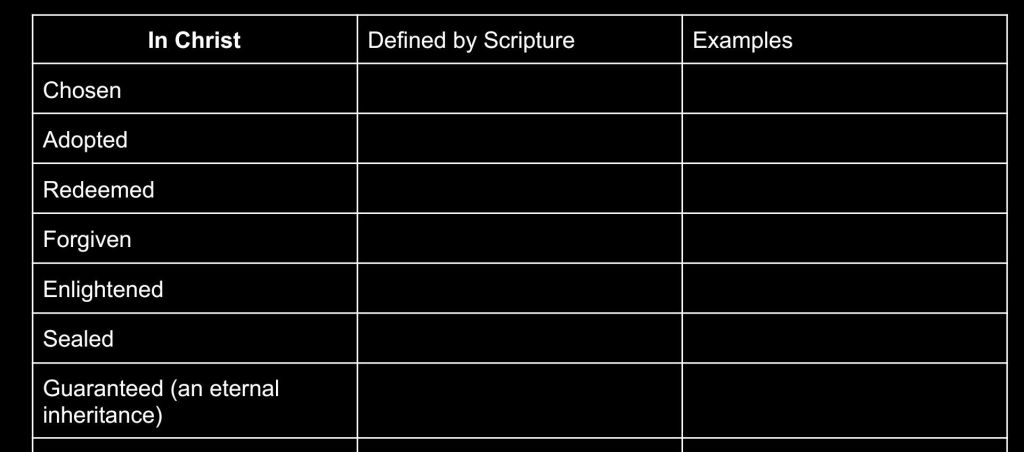
    There are at least seven blessings believers enjoy by being “in Christ,” according to Ephesians 1:3-14.

    The passage is pregnant with theological implications.

    Just reading through it quickly, and moving on, won’t do. Not if the goal is to understand what is being communicated by the Word of God here about God and about believers.

    It’s a deeply powerful section of Scripture which necessitates putting a pause on our reading to dig into the meaning here. What do each of these words mean, exactly? Could I explain to someone else with crystal clear clarity? Have I exhausted the Scriptures to see everything that comes to bear around these seven blessings (cross referencing verses, listening to sermons, referencing a concordance.

    Obviously, this approach can be applied to any section of Scripture, but this chapter is worth highlighting with a method that puts extra focus on extracting the meaning. It’s a recognition that there’s much to this text that speaks to Ultimate Reality, a world more real than the day-to-day of my existence, so there can be no higher pursuit than the pursuit of God, and this is just one to do that.

    It’s like taking a “faith pill,” a boost to your spiritual well-being that feeds other areas of your life because Jesus Himself said, “You shall know the Truth and the Truth shall set you free.”

    Create a chart, like the one below or a better one, and spend time filling it out and, more importantly, meditating on it.

    And thank Him and praise Him!

    Praise God from Whom all blessings flow
    Praise Him all creatures here below
    Praise Him above, you heavenly host
    Praise Father, Son and Holy Ghost

  • Excerpt of an excerpt.

    From a prior post:

    Christians are saints in Christ (1:1); blessed in Christ (1:3); chosen in Christ (1:4); adopted by Christ (1:5); lavished with love in Christ (1:6); redeemed and forgiven in Christ (1:7); participants in God’s good plan in Christ (1:11); glorified in Christ, sealed with the Holy Spirit (1:12-13); made alive in Christ (2:5-6); created in Christ (2:10); brought near to God in Christ (2:13); growing in Christ (2:21); built in Christ (2:22); and sharers in God’s promise in Christ (3:6). Get the picture? Everything in the universe is centered in Christ (1:10).

    -end-

    It’s a good idea to pause and reflect on all that, rather than quickly reading it and moving on. Read slowly enough to think about each concept, what that means, and how this reality might encourage a weary saint:

    Our Identity in Christ

    “Praise be to the God and Father of our Lord Jesus Christ, who has blessed us in the heavenly realms with every spiritual blessing in Christ. 4 For he chose us in him before the creation of the world to be holy and blameless in his sight. In love 5 he[b] predestined us for adoption to sonship[c] through Jesus Christ, in accordance with his pleasure and will— 6 to the praise of his glorious grace, which he has freely given us in the One he loves. 7 In him we have redemption through his blood, the forgiveness of sins, in accordance with the riches of God’s grace.. ” (Ephesians 1)

    We are:

    * Saints in Christ (1:1)
    * Blessed in Christ (1:3)
    * Chosen in Christ (1:4)
    * Adopted by Christ (1:5)
    * Lavished with love in Christ (1:6)
    * Redeemed and forgiven in Christ (1:7)

    In him we were also chosen,[e] having been predestined according to the plan of him who works out everything in conformity with the purpose of his will, 12 in order that we, who were the first to put our hope in Christ, might be for the praise of his glory. 13 And you also were included in Christ when you heard the message of truth, the gospel of your salvation. When you believed, you were marked in him with a seal, the promised Holy Spirit, 14 who is a deposit guaranteeing our inheritance until the redemption of those who are God’s possession—to the praise of his glory.
    Ephesians 1:11-17

    We are:
    * Participants in God’s good plan in Christ (1:11)
    * Glorified in Christ, and sealed with the Holy Spirit (1:12-13)

    “God … made us alive with Christ even when we were dead in transgressions—it is by grace you have been saved. 6 And God raised us up with Christ and seated us with him in the heavenly realms in Christ Jesus, 7 in order that in the coming ages he might show the incomparable riches of his grace, expressed in his kindness to us in Christ Jesus. 8 For it is by grace you have been saved, through faith—and this is not from yourselves, it is the gift of God— 9 not by works, so that no one can boast. 10 For we are God’s handiwork, created in Christ Jesus to do good works, which God prepared in advance for us to do…13 But now in Christ Jesus you who once were far away have been brought near by the blood of Christ.

    (Ephesians 2:5-10, 13)

    We are:
    * Made alive in Christ (2:5-6)
    * Created in Christ (2:10)
    * Brought near to God in Christ (2:13)
    * Growing in Christ (2:21)
    * Built in Christ (2:22)

    Ephesians 3:6 This mystery is that through the gospel the Gentiles are heirs together with Israel, members together of one body, and sharers together in the promise in Christ Jesus.

    We are
    * Sharers in God’s promise in Christ (3:6)


    Everything in the universe is centered in Christ (1:10).

  • 1. There is therefore now no condemnation to them which are in Christ Jesus.
    2For the law of the Spirit of life in Christ Jesus hath made me free from the law of sin and death.
    3For what the law could not do, in that it was weak through the flesh, God sending his own Son in the likeness of sinful flesh, and for sin, condemned sin in the flesh:
    4That the righteousness of the law might be fulfilled in us, who walk not after the flesh, but after the Spirit.
    5For they that are after the flesh do mind the things of the flesh; but they that are after the Spirit the things of the Spirit.
    6For to be carnally minded is death; but to be spiritually minded is life and peace.
    7Because the carnal mind is enmity against God: for it is not subject to the law of God, neither indeed can be.
    8So then they that are in the flesh cannot please God.
    9But ye are not in the flesh, but in the Spirit, if so be that the Spirit of God dwell in you. Now if any man have not the Spirit of Christ, he is none of his.
    10And if Christ be in you, the body is dead because of sin; but the Spirit is life because of righteousness.
    11But if the Spirit of him that raised up Jesus from the dead dwell in you, he that raised up Christ from the dead shall also quicken your mortal bodies by his Spirit that dwelleth in you.
    12Therefore, brethren, we are debtors, not to the flesh, to live after the flesh.
    13For if ye live after the flesh, ye shall die: but if ye through the Spirit do mortify the deeds of the body, ye shall live.
    14For as many as are led by the Spirit of God, they are the sons of God.
    15For ye have not received the spirit of bondage again to fear; but ye have received the Spirit of adoption, whereby we cry, Abba, Father.
    16The Spirit itself beareth witness with our spirit, that we are the children of God:
    17And if children, then heirs; heirs of God, and joint-heirs with Christ; if so be that we suffer with him, that we may be also glorified together.
    18For I reckon that the sufferings of this present time are not worthy to be compared with the glory which shall be revealed in us.
    19For the earnest expectation of the creature waiteth for the manifestation of the sons of God.
    20For the creature was made subject to vanity, not willingly, but by reason of him who hath subjected the same in hope,
    21Because the creature itself also shall be delivered from the bondage of corruption into the glorious liberty of the children of God.
    22For we know that the whole creation groaneth and travaileth in pain together until now.
    23And not only they, but ourselves also, which have the firstfruits of the Spirit, even we ourselves groan within ourselves, waiting for the adoption, to wit, the redemption of our body.
    24For we are saved by hope: but hope that is seen is not hope: for what a man seeth, why doth he yet hope for?
    25But if we hope for that we see not, then do we with patience wait for it.

    Our Victory in Christ
    26Likewise the Spirit also helpeth our infirmities: for we know not what we should pray for as we ought: but the Spirit itself maketh intercession for us with groanings which cannot be uttered.
    27And he that searcheth the hearts knoweth what is the mind of the Spirit, because he maketh intercession for the saints according to the will of God.
    28And we know that all things work together for good to them that love God, to them who are the called according to his purpose.
    29For whom he did foreknow, he also did predestinate to be conformed to the image of his Son, that he might be the firstborn among many brethren.
    30Moreover whom he did predestinate, them he also called: and whom he called, them he also justified: and whom he justified, them he also glorified.
    31What shall we then say to these things? If God be for us, who can be against us?
    32He that spared not his own Son, but delivered him up for us all, how shall he not with him also freely give us all things?
    33Who shall lay any thing to the charge of God’s elect? It is God that justifieth.
    34Who is he that condemneth? It is Christ that died, yea rather, that is risen again, who is even at the right hand of God, who also maketh intercession for us.
    35Who shall separate us from the love of Christ? shall tribulation, or distress, or persecution, or famine, or nakedness, or peril, or sword?
    36As it is written, For thy sake we are killed all the day long; we are accounted as sheep for the slaughter.
    37Nay, in all these things we are more than conquerors through him that loved us.
    38For I am persuaded, that neither death, nor life, nor angels, nor principalities, nor powers, nor things present, nor things to come,
    39Nor height, nor depth, nor any other creature, shall be able to separate us from the love of God, which is in Christ Jesus our Lord.

  • “It is curious and instructive to observe how history repeats itself, and how much sameness there is in the human heart in every age.”

    Excerpt from J.C. Ryle’s book, PRACTICAL RELIGION, first published in 1878.

    We live in an age of peculiar spiritual privileges. Since the world began there never was such an opportunity for a man’s soul to be saved as there isn’t an England at this time. There never were so many signs of religion in the land, so many sermons preached, so many services held in churches and chapels, so many Bibles sold, so many religious books and tracts printed, so many Societies for evangelizing mankind supported, so much outward respect paid to Christianity. Things are done everywhere now-a-days which a hundred years ago would have been thought impossible. Bishops support the boldest and most aggressive efforts to reach the unconverted. Deans and Chapters throw open the naves of cathedrals for Sunday evening sermons! Clergy of the narrowest High Church School advocate special missions, and vie with their Evangelical brethren in proclaiming that going to church on Sunday is not enough to take a man to heaven. In short, there is a stir about religion now-a-days to which there has been nothing like since England was a nation, and which the cleverest sceptics and infidels cannot deny. If Romaine, and Venn, and Berridge, and Rowlands, and Grimshaw, and Hervey, had been told that such things would come to pass about a century after their deaths, they would have been tempted to say, with the Samaritan nobleman,” If the Lord should make windows of heaven might such a thing be.” (2 Kings vii. 19.) But the Lord has opened the windows of heaven. There is more taught now-a-days in England of the real Gospel, and of the way of salvation by faith in Jesus Christ, in one week, than there was in a year in Romaine’s time. Surely I have a age of spiritual privileges. But are we any better for right to say that we live in an it? In an age like this it is well to ask, “How do we do about our souls?”

    We live in an age of peculiar spiritual danger. Never perhaps since the world began was there such an immense amount of mere outward profession of religion as there is in the present day. A painfully large proportion of all the congregations in the land consists of unconverted
    people, who know nothing of heart-religion, never come to the Lord’s Table, and never confess Christ in their daily lives. Myriads of those who are always running after preachers, and crowding to hear special sermons, are nothing better than empty tubs, and tinkling cymbals, without a jot of real vital Christianity at home. The parable of the sower is continually receiving most vivid and painful illustrations. The way-side hearers, the stony-ground hearers, the thorny-ground hearers abound on every side.

    The life of many religious professors, I fear, in this age, is nothing better than a continual course of spiritual dram-drinking. They are always morbidly craving fresh excite-ment; and they seem to care little what it is if they only get it. All preaching seems to come alike to them; and they appear unable to “see differences,” so long as they hear what is clever, have their ears tickled, and sit in a crowd. Worst of all, there are hundreds of young unestablished believers who are so infected with the same love of excite-ment, that they actually think it a duty to be always seeking it. Insensibly almost to themselves, they take up a kind of hysterical, sensational, sentimental Christianity, until they are never content with the “old paths,” and, like the Athenians, are always running after something new. To see a calm-minded young believer, who is not stuck up, self-confident, self-conceited, and more ready to teach than learn, but content with a daily steady effort to grow up into Christ’s likeness, and to do Christ’s work quietly and unostentatiously, at home, is really becoming almost a rarityl

  • He is not ashamed to call us brethren; so, surely, we ought bravely and joyfully declare that we are on His side.

    Excerpt from “The Secret of Love to God,” by
    Charles Haddon Spurgeon, sermon delivered August 15, 1880

    I cannot imagine a true man saying, “I love Christ, but I do not want others to know that I love him, lest they should laugh at me.” That is a reason to be laughed at, or rather, to be wept over. Afraid of being laughed at? O sir, this is indeed a cowardly fear! Are there not some of Christ’s servants, who live in the full glare of public observation, and whose names are ridiculed every hour of the day? Yet has that ridicule ever broken their bones, or their hearts? Verily, nay; and if God makes men of us, we ought never to be afraid of such a thing as a sneer, or a jeer, or a jest on account of our religion.

    Perhaps some will say that they do love Christ; but that, if they avowed their affection for him, they would provoke opposition. Of course you would; did not God himself say so to the serpent in the Garden of Eden, “I will put enmity between thee and the woman, and between thy seed and her seed”?

    Did you expect the woman’s seed to be loving the Lord, and yet not to be opposed by the serpent’s seed?

    Did not Jesus say to his disciples, “If ye were of the world, the world would love his own: but because ye are not of the world, but I have chosen you out of the world, therefore the world hateth you”? You know how the world treated him; and shall the disciple be above his Master, the servant above his Lord?

    So, my brethren, if you do love the Lord, say, “We love’ him,” for there is no good reason why you should not avow your affection for him; but, on the other hand, there is abundant reason why you should do so; for, first, Jesus Christ deserves and claims that avowal. He was not ashamed of his love for us. He left all the glories of heaven that he might espouse our cause; and when we came to his feet, burdened, and guilty, and full of woes, there was not one lovely trait in our character to attract him toward us; yet he took pity upon us, and loved us, and saved us; and now he pleads for us in heaven. He is not ashamed to call us brethren; so, surely, we night, bravely and joyfully, to declare that we are on his side.

         We ought not to need any urging to that avowal; but if we do, let us remember that Christ claims it, for he has said, “Whosoever therefore shall be ashamed of me and of my words in this adulterous and sinful generation; of him also shall the Son of man be ashamed, when he cometh in the glory of his Father with the holy angels.” And he also said, “Whosoever shall confess me before men, him shall the Son of man also confess before the angels of God: but he that denieth me” — and the apposition, you see, makes that word “deny ” mean “he that does not confess me” — “he that denieth me before men shall be denied before the angels of God.” Come, then, brothers and sisters, since Christ claims it, and so richly deserves it, let the avowal of this fact be made, if fact it be, “We love him.”

  • Except from  Charles Spurgeon sermon.

    It starts with a language of gratitude.

    “Blessed be the God and Father of our Lord Jesus Christ, who hath blessed us with all spiritual blessings in heavenly places in Christ: according as he hath chosen us in him before the foundation of the world, that we should be holy and without blame before him in love.” — Ephesians i. 3, 4.


    But how can we bless God? Without doubt, the lesser is blessed of the Greater. Can the Greater be blessed by the lesser? Yes, but it must be in a modified sense. God blesses us with all spiritual blessings; but we cannot give him any blessings. He needs nothing at our hand; and if he did, we could not give it.

    “If I were hungry,” saith the Lord, “I would not tell thee: for the world is mine, and the fullness thereof.” God has an all-sufficiency within himself, and can never be thought of as dependent upon his creatures, or as receiving anything from his creatures which he needs to receive. He is infinitely blessed already; we cannot add to his blessedness. When he blesses us, he gives us a blessedness that we never had before; but when we bless him, we cannot by one iota increase his absolutely infinite perfectness. David said to the Lord, “My goodness extendeth not to thee.” This was as if he had said, Let me be as holy, as devout, and as earnest as I may, I can do nothing for thee; thou art too high, too holy, too great for me to be really able to bless thee in the sense in which thou dost bless me.  

    PRAISE
    How, then, do we bless God? Well, I should say, first, that this language is the expression of gratitude. We say with David, “Bless the Lord, O my soul,” and we say with Paul, “Blessed be the God and Father of our Lord Jesus Christ.”

    We can bless God by praising him, extolling him, desiring all honour for him, ascribing all good to him, magnifying and lauding his holy name. Well, we will do that. Sit still, if you will, and let your heart be silent unto God; for no language can ever express the gratitude that, I trust, we feel to him who has blessed us with all spiritual blessings in Christ Jesus. Praise him also in your speech. Break the silence; speak to his glory. Invite others to cry with you, “Hallelujah!” or “Hallels unto Jah!” “Praise unto Jehovah!” Ascribe ye greatness unto our God. Oh, that all flesh would magnify the Lord with us!

    Say Amen When ..
    This language is also the utterance of assent to all the blessedness that is ascribed to the Lord. After hearing how great he is, how glorious he is, how happy he is, we bless him by saying, “Amen; so let it be! So would we have it. He is none too great for us, none too glorious for us, none too blessed for us. Let him be great, glorious, and blessed, beyond all conception.” I think that we bless God when we say concerning the whole of his character, “Amen. This God is our God for ever and ever.”

    Let him be just what the Bible says he is; we accept him as such. Sternly just, he will not spare the guilty. Amen, blessed be his name!

    Infinitely gracious, ready to forgive. Amen, so let it be!

    Everywhere present, always omniscient. Amen, so again do we wish him to be!

    Everlastingly the same, unchanging in his truth, his promise, his nature. We again say that we are glad of it, and we bless him.

    He is just such a God as we love. He is indeed God to us, because he is really God, and we can see that he is so, and every attribute ascribed to him is a fresh proof to us that Jehovah is the Lord. Thus, we bless him by adoration.

    Thy Kingdom Come
    We also bless God in the spreading of his kingdom. We can win hearts to him through his mighty grace blessing our service. We can fight against evil; we can set up a standard for the truth. We can be willing to suffer in repute, and every way else, for his name’s sake. We can by his grace do all this, and thus we are blessing God. Surely, dear friends, if it is well-pleasing in God’s sight that sinners should repent, if it makes heaven the gladder, and makes joy in the presence of the angels that men should repent, we are in the best and most practical way blessing God when we labour to bring men to repentance through faith in Christ Jesus.

    Love One Another
    There is also another way of blessing God which, I trust, we shall all endeavour to practise; and that is by the doing good to his children. When they are sick, visit them. When they are downcast, comfort them. When they are poor, relieve them. When they are hard pressed by outward adversaries, stand at their side, and help them. You cannot bless the Head, but you can bless the feet; and when you have refreshed the feet, you have refreshed the Head. He will say, “Inasmuch as ye have done it unto one of the least of these my brethren, ye have done it unto me.” If they be naked, and you clothe them; if they be sick, and you visit them; if they be hungry, and you feed them; you do in this respect bless God. David not only said, “Thou art my Lord: my goodness extendeth not to thee;” but he added, “but to the saints that are in the earth, and to the excellent in whom is all my delight.” You can be good to them, and in that respect you may be blessing God. He has done so much for us, that we would fain do something for him; and when we have reached the limit of our possibilities, we long to do more. We wish that we had more money to give, more talent to use, more time that we could devote to his cause, we wish that we had more heart and more brain; sometimes we wish that we had more tongue, and we sing,—

    “Oh, for a thousand tongues to sing
    My great Redeemer’s praise!”

    This word “blessed” is an attempt to break the narrow circle of our capacity. It is an earnest endeavour of a burning heart to lay at God’s feet crowns of glory which it cannot find: “Blessed be the God and Father of our Lord Jesus Christ.”

  • The Apostle Paul wrote the letter to the Ephesians while under house arrest in Rome.

    Ephesians 1:3-14

    3 Praise be to the God and Father of our Lord Jesus Christ, who has blessed us in the heavenly realms with every spiritual blessing in Christ.

    4 For He chose us in Him before the creation of the world to be holy and blameless in His sight.

    5-6 In love He predestined us for adoption to sonship through Jesus Christ, in accordance with His pleasure and will— to the praise of His glorious grace, which He has freely given us in the One He loves.

    7-10 In Him we have redemption through His blood, the forgiveness of sins, in accordance with the riches of God’s grace that He lavished on us. With all wisdom and understanding, He made known to us the mystery of His will according to His good pleasure, which He purposed in Christ, to be put into effect when the times reach their fulfillment—to bring unity to all things in heaven and on earth under Christ.

    11-12 In Him we were also chosen, having been predestined according to the plan of him who works out everything in conformity with the purpose of His will, in order that we, who were the first to put our hope in Christ, might be for the praise of his glory.

    13-14 And you also were included in Christ when you heard the message of truth, the gospel of your salvation. When you believed, you were marked in Him with a seal, the promised Holy Spirit, who is a deposit guaranteeing our inheritance until the redemption of those who are God’s possession—to the praise of His glory.

    Question: How can we bless God?

    Answer: See tomorrow’s post!

  • Do you know everything you have “in Christ”?

    Excerpt from “An Introduction to Be Rich by Ken Baugh.

    Before my wife Susan met me, she was dating a billionaire’s son. Yes, you read that right: billionaire. So as you can imagine, money was never an issue. In fact, if she had married this guy, she would have been set for life, at least financially. Can you imagine never having to worry about money? Never having to say no to anything, never having to be on a budget? You could buy whatever you wanted-sports cars, boats, planes, you name it. If you married into a billionaire family, you would be on the invite list to all the exclusive parties, you would be able to take exotic vacations and travel the world in Learjets and aboard private yachts. It sounds pretty nice, especially if things are tough for you financially.

    Thankfully for me at least instead of marrying a billionaire she married a guy who was at that time a wannabe pastor. When I met her, twenty-three years ago, I had maybe $150 to my name, and I was driving a 1979 Datsun B-210 hatchback with chrome-spoked rims and sheepskin seat covers. I didn’t have much. It’s true that Susan and I have never had a lot of money, but it’s also true that we have never been in need of much either. God has always been faithful to provide for our needs above and beyond what we ever imagined.

    Over the last twenty years as a pastor I have met a lot of very wealthy people, and if there is one thing I have learned as I have watched the rich and famous from the sidelines, it is that money doesn’t buy happiness. Money doesn’t bring peace or security. Money is here today and lost in the stock marker tomorrow. There is only one source of true wealth, only one means of lasting peace and security, and that is being in Christ. In fact, the Big Idea in Paul’s letter to the church in Ephesus is that every Christian is rich in Christ.

    “In Christ” is the most frequently used phrase in the book of Ephesians, and the point is clear: If you’re in Christ, you have everything.

    For example, Christians are saints in Christ (1:1); blessed in Christ (1:3); chosen in Christ (1:4); adopted by Christ (1:5); lavished with love in Christ (1:6); redeemed and forgiven in Christ (1:7); participants in God’s good plan in Christ (1:11); glorified in Christ, sealed with the Holy Spirit (1:12-13); made alive in Christ (2:5-6); created in Christ (2:10); brought near to God in Christ (2:13); growing in Christ (2:21); built in Christ (2:22); and sharers in God’s promise in Christ (3:6). Get the picture? Everything in the universe is centered in Christ (1:10).

    As a Christian you are in Christ, and being in Christ simply means that you are part of the family of God. You’re so wealthy, it makes a billionaire family seem like paupers.

  • Addictions, depression, broken families, greed, avarice, violence and all the other proceeds of living in a sinful world — a lost world — cannot be addressed unless God’s people answer Christ’s clarion call.

    Excerpt from David Shaw’s “You are the light of the world. A city set on a hill cannot be hidden.” If we the Church are not the Salt & Light – who else is there?”

    “You are the light of the world. A city set on a hill cannot be hidden. Nor do people light a lamp and put it under a basket, but on a stand, and it gives light to all in the house. In the same way, let your light shine before others, so that they may see your good works and give glory to your Father who is in heaven.”  Matthew 5:14-16

    The Beatitudes are not to be lived in isolation or only among fellow believers, but everywhere we go, in all aspects of our lives. God’s only witnesses are believers, and the world has no other way of knowing of Him except through the testimony of who we are in Christ.

    “Evil people and impostors will go on from bad to worse, deceiving and being deceived” (2 Tim. 3:13). The world cannot do anything but get worse, because it has no inherent goodness to build on, no inherent spiritual and moral life in which it can grow. Year after year the system of evil accumulates a deeper darkness. We can look around at the culture and the world we live in and see the moral entropy that sin has brought upon us…

    The world is full of lost souls who cannot see their way out of the quagmire they find themselves in. Addictions, depression, broken families, greed, avarice, violence and all the other proceeds of living in a sinful world, a lost world, cannot be addressed unless God’s people answer Christ’s clarion call. How will the lost find their way to the Father’s house unless the Father’s house, acting as salt and light, reach out to them? Our work is not only as individual grains of salt or as individual rays of light but it is as the whole church of Jesus Christ.

    As individuals we are called on to reflect Christ’s love as a testament to who we are and who He is. People should see Christ in us to the extent that they desire what we have. The joy that we have in Christ is such that we should long that others would also have that very same joy. Salt and light represent what we as Christians are. The only question, as Jesus goes on to say, is whether or not we are tasteful salt and effective light. The very fact that we belong to Jesus Christ makes us His salt and light in the world.

    One aspect of Church life that has often distressed me is when a Church sits back and waits for the world to come to them. No meaningful outreach to a dying world. A Church that sits in the proverbial holy huddle is not salt and light. No matter how rich the intra-Church family life is that Church is not obeying Christ’s teaching in Matthew 5:13-16.

    Our witness to this culture is commanded not suggested. Our witness as individuals and as a Church are to be a reflection of Christ Himself. We are not to reflect badly on Him. Remember that our salt should not lose it saltiness, our light should not be hidden to the world. We must understand fully that our salt and light is to bring glory to our Father in Heaven and our Lord Jesus Christ. Our lives are to bring glory to the creator of the universe, the author of our salvation, the Alpha and Omega, the Ancient of days, the Beginning and the End, the Blessed Hope, the Desire of all Nations, and the Eternal Father.

    Letting our light shine before men allows them to see our good works, the beauty the Lord has worked in us. To see good works by us is to see Christ in us. That is why Jesus says, let your light shine. It is not something we create or make up, but something we allow the Lord to do through us. It is God’s light; our choice is whether to hide it or let it shine.

  • The self-testimony of Scripture is powerful.

    Excerpt from Terry Johnson’s “Yes, Scripture Reading Really Does Change People.”


    ” … evangelicals shouldn’t require anecdotal testimonies of the transformative power of Scripture reading. After all, we have Scripture’s own self-testimony.

    Are we not said to be born again by the “living and abiding word”? Do we not come to faith by “hearing the word of Christ”? Do we not grow by the pure milk of God’s Word?

    Are we not sanctified by the truth of God’s Word? Is the Word of grace not able to build us up and give us an eternal inheritance?

    Is the gospel Word of truth not constantly bearing fruit and increasing? Is the Word of God not living and active and sharper than a two-edged sword? Is the gospel not the power of God for salvation?

    I could go on:

    1 Peter 1:23–25
    23 having been born again, not of corruptible seed but incorruptible, through the word of God which lives and abides forever,
    24 because
     “All flesh is as grass,
     And all the glory of man as the flower of the grass.
     The grass withers,
     And its flower falls away,
    25 But the word of the Lord endures forever.”
    Now this is the word which by the gospel was preached to you.

    Romans 10:17
    So then faith comes by hearing, and hearing by the word of God.

    1 Peter 2:2
    As newborn babes, desire the pure milk of the word, that you may grow thereby,

    John 17:17
    Sanctify them by Your truth. Your word is truth.

    Acts 20:32
    So now, brethren, I commend you to God and to the word of His grace, which is able to build you up and give you an inheritance among all those who are sanctified.

    Colossians 1:6
    … which has come to you, as it has also in all the world, and is bringing forth fruit, as it is also among you since the day you heard and knew the grace of God in truth;


    Hebrews 4:12
    For the word of God is living and powerful, and sharper than any two-edged sword, piercing even to the division of soul and spirit, and of joints and marrow, and is a discerner of the thoughts and intents of the heart.

    Romans 1:16
    For I am not ashamed of the gospel of Christ, for it is the power of God to salvation for everyone who believes, for the Jew first and also for the Greek.

    Ephesians 6:17
    Take the helmet of salvation and the sword of the Spirit, which is the word of God.

    1 Thessalonians 2:13
    For this reason we also thank God without ceasing, because when you received the word of God which you heard from us, you welcomed it not as the word of men, but as it is in truth, the word of God, which also effectively works in you who believe.

    2 Timothy 3:15
    … and that from childhood you have known the Holy Scriptures, which are able to make you wise for salvation through faith which is in Christ Jesus.

    Jeremiah 23:29
    “Is not My word like a fire?” says the Lord,
    “And like a hammer that breaks the rock in pieces?

    Isaiah 55:11
    So shall My word be that goes forth from My mouth;
    It shall not return to Me void,
    But it shall accomplish what I please,
    And it shall prosper in the thing for which I sent it.

    1 Thessalonians 1:5
    For our gospel did not come to you in word only, but also in power, and in the Holy Spirit and in much assurance, as you know what kind of men we were among you for your sake.

    James 1:21
    Therefore lay aside all filthiness and overflow of wickedness, and receive with meekness the implanted word, which is able to save your souls.

  • Letting go is the acknowledgement that God is in control.

    “Letting Go,” a poem from The Grace Awakening by Chuck Swindol

    To let go doesn’t mean to stop caring,
    it means I can’t do it for someone else.


    To let go is not to cut myself off,
    it’s the realization that I can’t control another.


    To let go is not to enable,
    but to allow learning from natural consequences.


    To let go is to admit powerlessness,
    which means the outcome is not in my hands.


    To let go is not to try to change or blame another,
    I can only change myself.


    To let go is not to care for,
    but to care about.


    To let go is not to fix,
    but to be supportive.


    To let go is not to judge,
    but to allow another to be a human being.


    To let go is not to be in the middle arranging all the outcomes,
    but to allow others to effect their own outcomes.


    To let go is not to be protective,
    but to permit another to face reality.


    To let go is not to deny,
    but to accept.


    To let go is not to nag, scold, or argue,
    but to search out my own shortcomings and to correct them.


    To let go is not to adjust everything to my desires,
    but to take each day as it comes.


    To let go is not to criticize and regulate anyone,
    but to try to become what I dream I can be.


    To let go is not to regret the past,
    but to grow and live for the future.


    To let go is to fear less and love more.